What started as a bold attempt to commercialise aquaponics has matured into a scalable fresh-produce business with ambitions well beyond Namibia’s borders. For the Oribi Aquaponics Group, hard lessons, strict system discipline and strategic infrastructure investment have laid the foundation for regional expansion across Southern Africa.
“When we entered the commercial space, we quickly realised how big the gap is between a hobby system and a reliable production unit,” says Ryno Postma, Commercial Director of Oribi Aquaponics. “The learning curve was steep, and consistency was our biggest challenge at the start.”
Early production cycles were marked by fluctuations that might be manageable for small-scale growers, but not for a business supplying formal retail markets. The turning point came when the team conducted an uncompromising review of every process in their system.

(Image source: www.hortidaily.com)
“One of the biggest breakthroughs was understanding the importance of small, regular water changes,” Ryno explains. “That single adjustment had a major impact on plant health and growth uniformity. From there, everything changed.”
Today, Oribi operates a 2 500 m² aquaponic system housed within a 5 000 m² greenhouse outside Okahandja, north of Windhoek. An expansion currently nearing completion will see the entire greenhouse brought into production, effectively doubling aquaponic growing capacity to 5 000 m².
But scale, Ryno emphasises, is only one part of the strategy. “We are not simply repeating what already works,” he says. “Alongside the aquaponic expansion, we’re investing in a dedicated seedling facility, a net house for soil-based crops and a significantly larger packhouse to handle increased output.”
This integrated production model supports a diverse crop basket of 20 to 25 vegetable lines, including 11 lettuce varieties. Celery, in particular, has emerged as a strong performer.

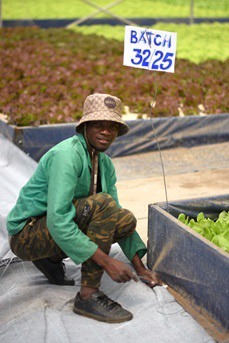
Oribi Aquaponics’ commercial operation near Okahandja, supplying fresh produce to Namibia’s growing local market. (Image source: www.hortidaily.com)
Supporting local supply and lowering prices
Oribi’s expansion aligns closely with Namibia’s import substitution drive, and the impact is already visible on retail shelves. By producing high-value, highly perishable leafy greens locally, the company has shortened supply chains and reduced costs for retailers and consumers alike.
“Premium pillow-pack lettuce used to travel around 1 600 kilometres from Johannesburg before reaching Namibian stores,” Ryno explains. “By producing locally, we’ve reduced prices by between 30% and 50%, while also improving shelf life and consistency.”
Consumer behaviour has responded in kind. While unwashed iceberg lettuce traditionally dominated the market, Namibian consumers are increasingly embracing a wider range of fresh, ready-to-use leafy greens. Oribi supplies several major retailers, including Food Lovers Market, Spar, Woermann Brock (only trading in Namibia) and Freshmark, the fresh-produce division of Checkers.

With enhanced systems and increased capacity, Oribi Aquaponics is ready to meet growing market demand. (Image source: www.hortidaily.com)
The company’s success with celery has further strengthened its regional outlook. “Since we increased local production, Namibia’s reliance on imported celery has dropped substantially,” says Ryno. “That immediately highlighted opportunities in neighbouring countries. Zambia, for example, imports far more celery than Namibia, and from much further away. There’s no reason that the market can’t be supplied regionally.”
Rethinking aquaponics at scale
For growers considering commercial aquaponics, Ryno is quick to caution against oversimplification. “The most common misconception is believing the fish will take care of everything,” he says. “That mindset almost guarantees failure somewhere in the system.”
At Oribi, precision management replaces assumptions. The team has developed a custom production-tracking system that monitors every variable, enabling consistent cropping cycles and up to 11 lettuce harvests per year.
Fish health remains essential, but even a well-managed tilapia population does not eliminate the need for intervention. “One of our biggest lessons was recognising that fish waste doesn’t supply every micronutrient plants require,” Ryno explains.
“Supplementation is simply part of commercial aquaponics if you want optimal growth.”

Operating in Namibia’s arid climate adds another layer of complexity. Water quality and salt accumulation must be managed carefully within a closed-loop system. “Like hydroponics, nutrients are salt based, so buildup needs to be controlled,” says Ryno. “At times, the system needs flushing, but that has to be done responsibly within a circular model.”
Crop selection is also strategic. While herbs such as basil and mint thrive in the aquaponic environment, others, including rosemary, are grown in soil systems supplemented with compost produced on-site.
Building more than volume
With expanded capacity and refined systems, Oribi Aquaponics is positioning itself among the largest operational aquaponics farms on the continent. Yet for Ryno, size alone is not the ultimate benchmark of success.
“It may sound impressive to say you’re one of the biggest,” he concludes, “but what really matters is producing a consistently high-quality product, creating employment, satisfying your customers and contributing to a stronger, more resilient regional food system. That’s the model we’re committed to building.”
For more information about Oribi Aquaponics, watch the video here.
References:
• HortiDaily. (2025, November 20). Namibian aquaponics group geared for regional expansion. HortiDaily.
• The Namibian Farmer. (2025, November 20). Oribi Aquaponics scales up for regional market dominance. NamibianFarming.
• Business Express. (2025). How Oribi Aquaponics is conquering the desert and eyeing regional dominance. NambusinessExpress.