In the Amersfoort district, where weather patterns and seasonal windows leave little room for error, time management plays a decisive role in the success of a farming operation. At Kojo Farming, every planting window must be used to its full potential to ensure that the large cropping enterprise – including soybeans, maize and hay production – is established on time.
Kojo Farming also has a well-established livestock division, with Merino and Drakensberger stud herds that further strengthen the business.
Fendt for Kojo’s mechanisation needs
So where did the need for high-horsepower tractors at Kojo Farming originate? The demand developed primarily as the farming operation expanded over the years. With the growth of the cropping enterprise, it became essential to upgrade the tractor fleet to handle increased workloads and shorter planting windows efficiently.
Kojo Farming had a clear set of requirements for new tractors. They needed advanced technology, sufficient pulling power to handle large implements and efficient fuel consumption. Various tractor brands were carefully evaluated before a final decision was made – and ultimately, Fendt was selected.
A tractor for every task
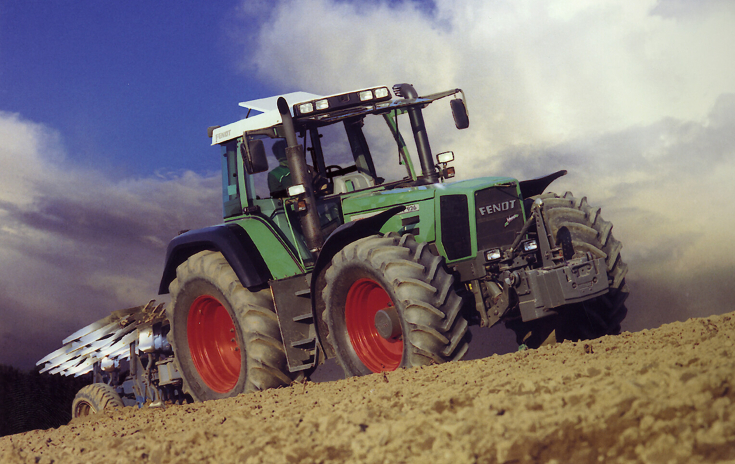
Kojo Farming has acquired three Fendt 1050 tractors. Johan du Plessis (“Dup”), farm manager of the cropping division, explains that these tractors fulfil a highly versatile role on the farm.
According to him, the tractors are used for a range of tasks, including land preparation, planting and hauling grain carts during harvest.
“What stands out for us about the tractors on the farm is the fact that they deliver exceptional power, but at much lower engine revolutions to put that power onto the ground,” Dup explains.
“The tractors are also very reliable and we have had no problems with them. Their versatility and ability to be used across different operations make them an excellent fit for our farming system.
“At Kojo Farming, we always aim to make the most of the short planting window we have in the Amersfoort and Mpumalanga region. We also allow our livestock to graze crop residues for an extended period, which further limits planting time. This makes it extremely important for us to do more work in less time.”

The Fendt 1050 in operation during planting at Kojo Farming.
Fendt for Kojo’s tillage requirements
Kojo Farming’s soil preparation practices revolve around a combination implement – the Väderstad TopDown 700 – which is used after livestock are removed from the fields. Because lands are grazed for a relatively long period, tillage operations only begin later in winter.
The TopDown 700 combination implement includes disc cultivation, tine cultivation, and levelling and rolling to ensure proper soil consolidation. The aim is to complete all operations in a single pass so that the soil is ready for planting immediately after cultivation. This approach helps maximise efficiency within the short planting window.
According to Werner Nel of JWL Agriculture, large combination implements are often described as “a handbrake on a tractor” because they require substantial power to pull. This is precisely where the Fendt 1050 demonstrates its strength and capability.
Werner explains that such implements require the right balance of power and ground speed to operate effectively. Unlike three-point implements, trailed implements affect tractor loading and tyre pressure differently – both critical factors in optimising tractor performance. With trailed implements, correct weight distribution is particularly important, and according to Werner, the Fendt 1050 is specifically designed to manage this efficiently.
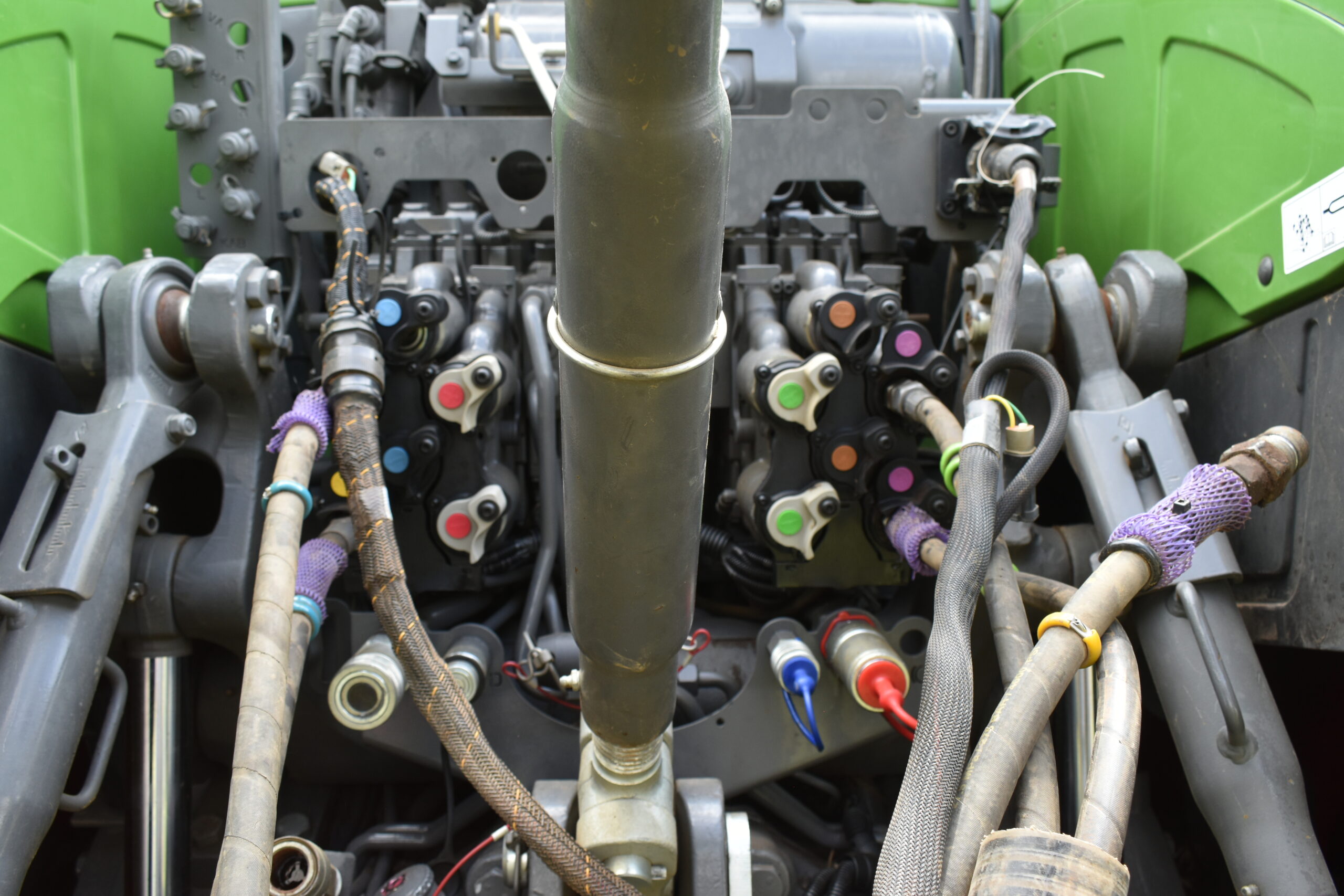
The Fendt tractors’ separate hydraulic tank and dual pumps with valve banks ensure constant oil flow and pressure, enabling accurate seed placement and optimal plant establishment.
Weight distribution and tyre pressure
The Fendt 1050 tractors are equipped with a front weight block available in different weight options. This allows farmers to optimise weight distribution for different applications – a lighter block for certain tasks and a heavier one for others. The tractor can also be operated without a front weight frame if required.
According to Werner, the Highveld presents its own mechanisation challenges. He notes that power per hectare (kW/ha) is directly linked to the capital investment required for equipment and tractors to work a given area.
“The decision to invest in these tractors was therefore not only about brute pulling power – it was about optimal functionality, weight distribution and overall farm efficiency,” he says.
Planting season with Fendt at Kojo
Following soil preparation, the Fendt 1050 tractors are also used to plant soybeans and maize. Although the power requirements for planters are lower, the same tractor can perform both tasks efficiently.
Kojo uses 24-row Equalizer planters during planting, with a row spacing of 76 cm. Like all wide-span planters, these conventional units have specific hydraulic and power requirements.
Although the tractors are not fitted with row-crop tyres, the versatility and adaptability of the Fendt allow for tyre pressure adjustments and lighter loading. This helps minimise soil compaction on planting rows, even when traffic occurs on those rows.
An optional onboard compressor system is also available, allowing tyre pressure to be adjusted directly from the cab – further improving efficiency and operator convenience.
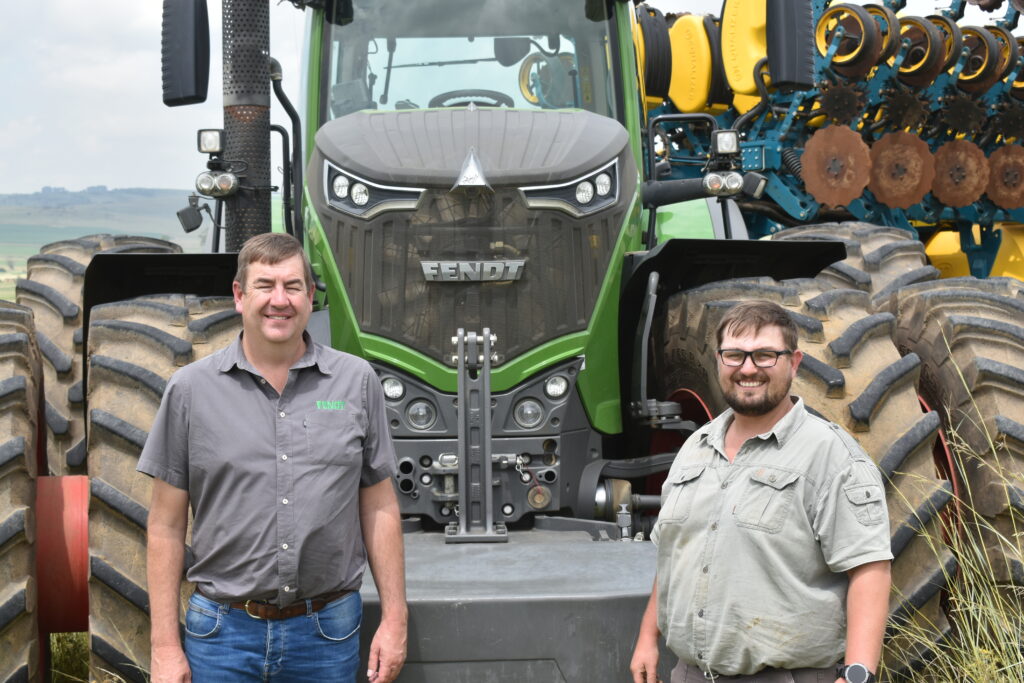
Werner Nel of JWL Agriculture and Johan du Plessis (Dup) next to one of Kojo Farming’s Fendt 1050 tractors.
Hydraulic capacity for precision planting
Wide-span planters have specific hydraulic demands, and this is where the Fendt 1050 proves its value. The tractors feature a separate hydraulic tank for external hydraulic circuits and are equipped with two hydraulic pumps, each serving its own valve bank.
Each bank has three outlets, ensuring a constant oil flow and pressure for the planter. This guarantees accurate seed placement and contributes to an optimal plant stand.
Lower engine speeds and higher torque
The Fendt 1050 tractors are powered by a MAN engine with a distinctive characteristic: very low engine speeds combined with high torque. The tractor idles at just 650 rpm, while maximum torque is already available at around 1 100 rpm, and maximum engine speed is approximately 1 700 rpm.
This combination of high torque and low engine speeds contributes to excellent fuel efficiency.
Benefits of low revs and Vario transmission
A key advantage of Fendt’s Vario transmission is that it uses only the engine power required for the task. This allows the engine to operate at much lower speeds while maintaining the same ground speed, significantly reducing fuel consumption.
“We’ve noticed that the low engine speeds result in exceptionally low fuel consumption on the farm,” Dup adds.
Choose Fendt as your long-term partner
If you want to take your farm’s mechanisation to the next level and optimise your power requirements, Fendt offers a compelling solution. At Kojo Farming, the Fendt tractors are used year-round across a wide range of tasks – demonstrating their versatility and value.
The tractors also come with a five-year, 5 000-hour warranty, providing peace of mind and supporting stronger resale value for farmers.
For more information on Fendt’s world-class tractors, visit https://www.fendt.com/za/ or JWL Agriculture’s website at https://jwlermelo.co.za/