Agriculture is moving faster than ever towards an era where technology, data, and intelligent machinery determine the difference between average and exceptional performance. At this year’s NAMPO Harvest Day, it became clear that the future of harvesting is already here as Case IH introduced their new flagship AF9 combine harvester to South African farmers.
With its impressive combination of high capacity, advanced automation, and enhanced design, the AF9 immediately attracted the attention of farmers, contractors, and agricultural specialists. The new harvester has been developed to meet the growing demands of modern farming, where time, fuel efficiency, crop quality, and data-driven decision-making have become more important than ever.
Smarter design. Greater capacity. Lower losses.
According to Bertus Barkhuizen, Product Specialist at Case IH, the AF9 builds on decades of refinement in grain handling, separation efficiency, and operator comfort, while taking harvesting capacity and performance to an entirely new level.
He explains: “What distinguishes the new Case IH AF9 from previous generations of harvesters is that it is not simply an upgrade of existing technology, but a completely redesigned model developed and manufactured for the challenges and expectations of the modern farmer.”
One of the AF9’s most impressive features is its massive 20 000-litre grain tank. “During trials near Middelburg in Mpumalanga, the harvester averaged around 16 tonnes of soybeans before unloading was required,” Bertus adds.
This is a significant advantage that reduces downtime and increases productivity during critical harvesting windows.
However, the AF9 is about far more than capacity and electronics. The machine has been purposefully designed to help farmers harvest faster, minimise losses, and maintain superior grain quality, even under difficult and changing conditions.
From the feeder house to the cleaning and residue management systems, the AF9 is an entirely new design while still retaining the renowned Axial-Flow single-rotor concept for which Case IH is known worldwide. Unlike conventional harvesters that separate grain through multiple threshing stages, the Axial-Flow system uses a single rotor to complete threshing and separation in a single continuous process.
This results in improved crop flow through the machine, reduced grain damage, and better crop quality.

Bertus Barkhuizen, product specialist at Case IH, explains the technology behind the new AF9.
Larger tank, faster flow and less downtime
“When harvesting, it is ultimately the combine that tells the real story. You can do everything right throughout the season, but your measure of success remains what you harvest. For a farmer, it is important that every kernel ends up in the tank and not on the ground,” says Bertus.
Key features of the AF9:
- The AF9 features a massive 20 000-litre grain tank, currently unique in South Africa within this specification.
- It offers an impressive unloading rate of 159 litres per second, allowing the tank to be emptied in approximately three to four minutes. This significantly reduces downtime and increases harvesting efficiency, especially during short and unpredictable weather windows when every minute counts.
- The cleaning system has been redesigned to deliver improved performance in uneven field conditions. Instead of grain falling directly onto the sieves, it first lands on a grain pan that moves both front-to-back and side-to-side. This motion distributes material more evenly across the cleaning area and improves efficiency.
- The feeding system has been completely redesigned. The feeder house is now shorter but larger, while the synchronised feeding system accelerates crop flow before it reaches the rotor. By synchronising crop intake with rotor speed, the system ensures more consistent feeding, reduces stress on the threshing mechanism, and improves overall crop flow through the machine.
- The rotor itself is approximately 860 mm longer than previous flagship Case IH models, creating additional separation area through two extra sets of concaves. This design improvement enhances threshing performance and reduces grain losses at the rear of the machine.
- Load sensors continuously monitor material distribution and automatically adjust grain flow to prevent one side of the machine from becoming overloaded. This intelligent adjustment helps maintain consistent performance, even in challenging terrain.
- Fuel efficiency has also been improved. The AF9 delivers approximately 1,5% better fuel economy than comparable Class 8 combines, consuming around 10 litres per hectare during soybean harvesting compared to approximately 14 litres per hectare under similar conditions.
- The machine weighs approximately 30 tonnes unloaded and is available in both tracked and four-wheel-drive configurations.
Enhanced operator comfort, improved power delivery, and a simplified drivetrain
Inside the cab, operators have access to two Pro 1200 touchscreen displays. One screen can focus on harvester performance, while the other displays grain quality, harvest data, and information from Case IH’s FieldOps platform. Through FieldOps, farmers can remotely communicate with Case IH support teams and factory technicians for diagnostics and technical assistance when required.
Bertus explains: “One of the biggest engineering changes is the repositioning of the 635 hp (474 kW) engine, which now runs parallel to the rotor instead of being mounted across the machine. This creates a more direct power transfer to the rotor and propulsion systems, improving efficiency and reducing driveline losses.Furthermore, the drive system has been simplified by reducing the number of belts, pulleys, and chains and incorporating more hydraulically driven systems. Fewer moving parts mean lower maintenance requirements, greater reliability, and reduced power losses.”
Smart residue management and intelligent automation
The AF9’s residue management system has also been significantly upgraded to ensure more precise and consistent residue distribution across the field.
Radar sensors monitor wind conditions in real time and automatically adjust spreading patterns to maintain an even distribution of residue.
This helps prevent chaff and fine material from being blown into neighbouring fields or crops.
Many of these functions are controlled by Case IH Harvest Command, an artificial intelligence-driven automation system. The technology continuously analyses crop conditions, feed rate, grain quality, and engine load, making real-time adjustments before operators even notice significant changes in harvesting conditions.
For example, farmers can set the harvester to operate at a maximum of 90% engine capacity. The machine then automatically adjusts ground speed and threshing settings to balance grain quality and harvesting performance. If conditions improve, the harvester increases its speed; if grain quality begins to decline, rotor speed, sieve settings, and airflow are automatically adjusted.
Cameras inside the grain tank continuously monitor grain quality and kernel damage. This visual data is fed into the system, allowing it to further refine settings and continuously optimise the harvesting process.
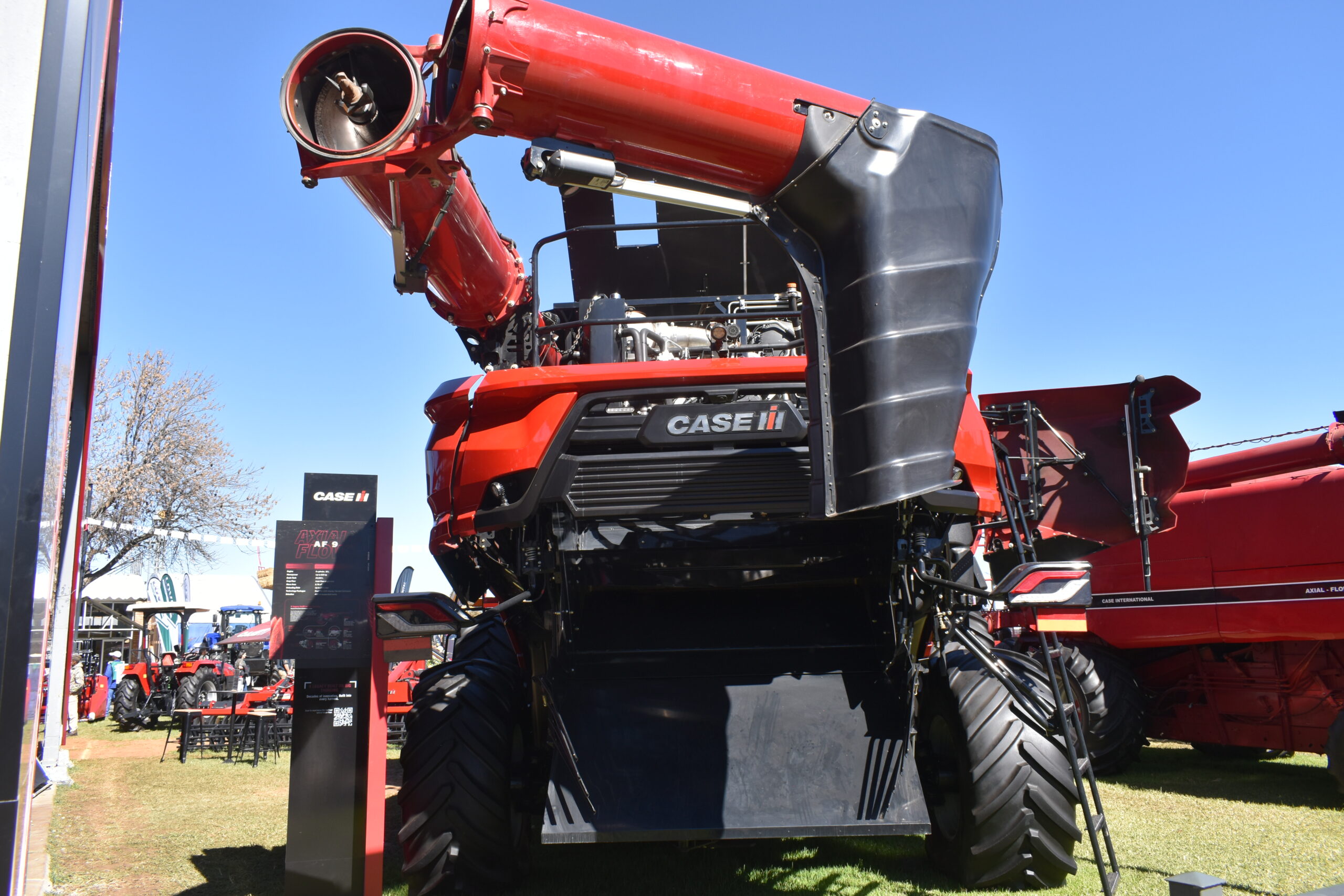
The redesigned rear section of the Case IH AF9 reflects a focus on efficient residue management, improved airflow, and a clean, functional design for maximum field performance.
Demonstration days
The Case IH team is excited to demonstrate the new AF9 to farmers across the country and show firsthand how the harvester performs under different conditions and real-world field environments on farmers’ own land.
Farmers are encouraged to follow Case IH’s social media platforms for information on upcoming demonstration events. Additional information is also available on the Case IH website.