Why should I choose LiuGong? This seems to be the question on many people’s minds. The answer is simple: they have proven themselves repeatedly.
With a sales volume and market share ranking them first in the industry for the past five years, with over 17 000 units operating worldwide, and 44 million hours of real-world working condition data, the numbers speak for themselves – a testament validated by LiuGong customers through actual daily operations.
Charging piles and transformers are the foundation for efficient electric equipment operations. When you use electric machinery on your site, these machines are the key to cost reduction and efficiency improvement. They act as a vital lifeline for LiuGong electric machines, transforming heavy-duty, zero-emission battery equipment into continuous, 24/7 production tools. By delivering rapid power, they eliminate extended downtime and allow operators to fully and quickly recharge massive machines.
What is a charging pile?
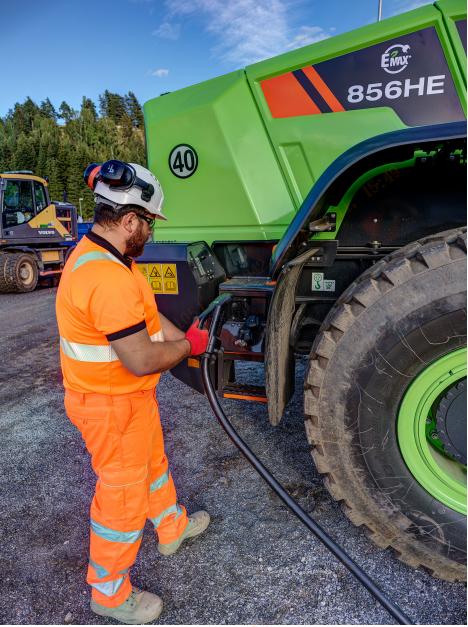
A charging pile is a dedicated device to top up electrical energy for electric vehicles, electric construction machinery and other heavy equipment. A charging pile works like a gas station, but for electric vehicles. Its core function is to safely and efficiently transfer electrical energy from the power grid or an energy storage system to the on-board battery through the charging interface.
Types of charging piles
Depending on the charging needs of your machine, there are two types of charging piles:
- An AC charging pile outputs an alternating current (AC) and relies on the machine’s on-board charger for electricity conversion. This is used with relatively low power (3 kW to 22 kW) and is best suited for slow charging.
- A DC charging pile directly outputs direct current (DC) with high power (60 kW and above), making it the ideal choice for the rapid recharging of heavy electric construction machinery.

What a charging pile consists of
A DC charging pile combines three core elements: hardware, software and a specialised internal structure.
- The hardware components include your charging gun, heavy-duty cables, controller, electricity meter and cooling system.
- Software components include charging control algorithms, safety monitoring systems, and a remote management platform.
- The internal structure refers to the internal layout that houses the human-machine interaction module (the screen and user interface), the control and communication system, the charging module and the power distribution system.
Cooling your charging pile
When large amounts of electricity move through electrical components, the internal resistance inside the power electronics and heavy cables generates extreme heat. That is why it is essential to cool your charging piles.
There are two primary ways to cool down a charging pile:
- Air-cooled charging pile: Uses fans for forced-air heat dissipation. This is the most popular cooling choice on the market. It has a lower upfront cost, an integrated design and requires simple, reliable maintenance. However, it needs thicker, heavier cables, and the single-gun current is typically limited to .
- Liquid-cooled charging pile: Circulates liquid coolant for heat dissipation, which achieves an efficiency approximately 25 times that of air-cooling. It is ideal for high-power applications of 300 kW and above. While it costs 30% to 50% more and requires more complex maintenance (including leak prevention and periodic coolant replacement), it allows for lighter, thinner cables and a single-gun current of .
Charging interface
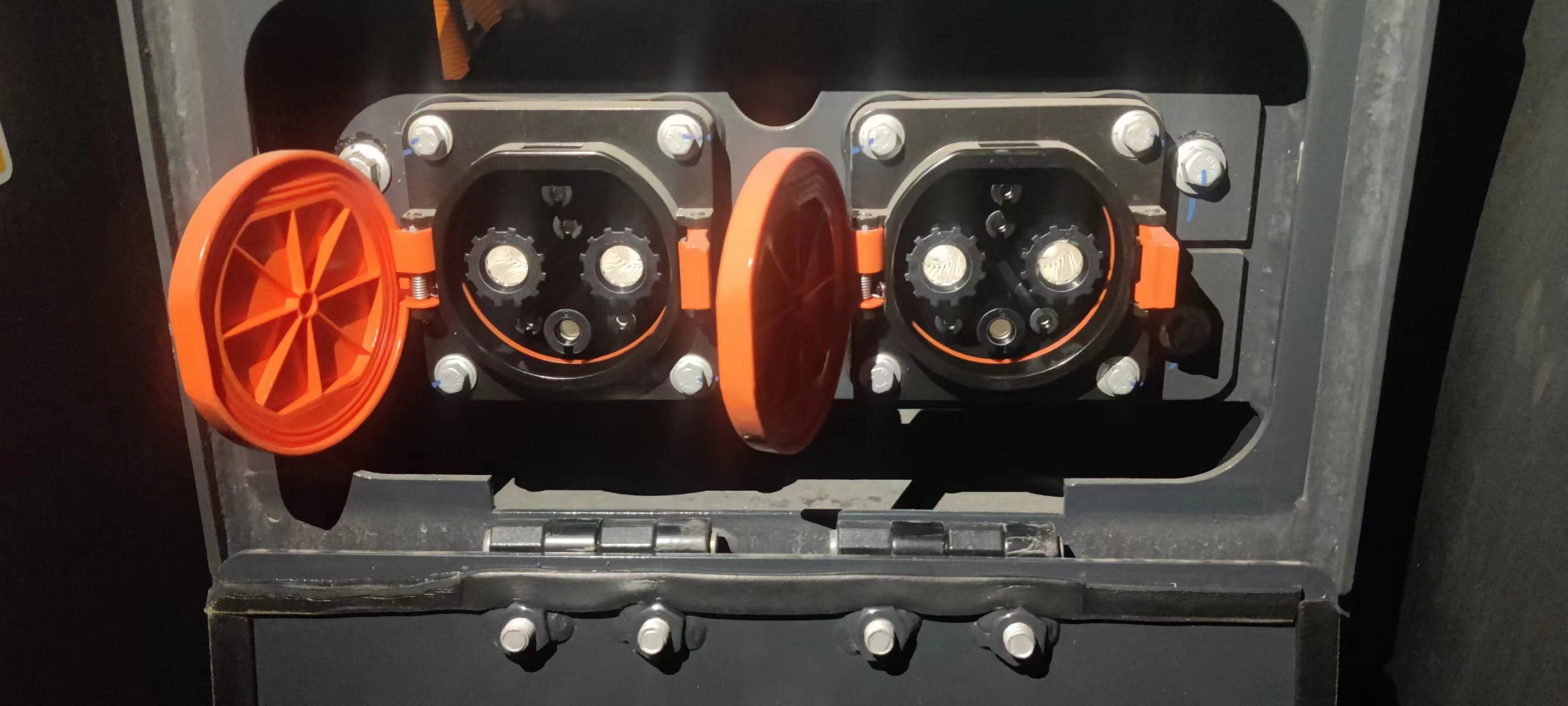
The GB/T standard charging interface is the primary charging interface used in Africa, with several LiuGong products equipped with dual guns as standard.
The GB/T interface refers to the Chinese charging interface standard (based on GB/T 20234). LiuGong’s electric excavators and electric wheel loaders all fully support this interface.
 |
 |
Why you should choose LiuGong charger piles
When it comes to choosing the right charging infrastructure, LiuGong has exactly what you need. These piles offer:
- Compatibility with LiuGong products and working conditions: The charging piles are specifically engineered for LiuGong electric construction machinery. They are highly adaptable to tough applications, including mining, aggregate yards, ports, construction sites and industrial plants.
- Appearance and types: GB/T standard charging piles are available in vertical, dual-gun and integrated designs featuring LiuGong’s clean green-and-white colour scheme. They come in multiple power specifications, including 80 kW, 160 kW, 240 kW and 320 kW.
- Making the right selection: When selecting a charging pile, you should consider your required charging time, budget and vehicle compatibility. A larger, higher-power charging pile is backwards-compatible with lower-power machinery. However, attempting to charge a high-capacity machine with a smaller pile will result in significantly longer charging times.
 240 kW to 320 kW |
 80 kW to 160 kW |
Charging pile installation requirements
Installing a heavy-duty charging pile requires adherence to strict environmental and electrical guidelines:
- Environmental requirements: Choose a space where the operating temperature range is between -20 °C and 65 °C, and the machine is placed at an altitude of . The pile must be installed on a solid concrete foundation elevated 200 mm above ground level, with a surface inclination of . The site must feature proper drainage and be positioned far away from fire sources or corrosive gases.
- Power supply requirements: The input voltage requires a three-phase system at 323 to 437 V with a frequency of 50/60 Hz. The transformer’s remaining capacity must be carefully calculated using the formula (for example, a 160-kW pile requires a transformer capacity of ). Handily, this system is fully adaptable to the various voltage standards commonly found across Africa.