In the heart of Mpumalanga, just outside Ermelo, Petrus Taljaard farms Drakensberger cattle, a stud that carries as much value as identity. For Petrus, identifying his livestock is not just an administrative duty, but a core part of effective management, traceability and proof of ownership.
That’s why he switched from the traditional hot branding to the innovative freeze branding technique with dry ice from Dry Ice 4 Farming and says he won’t look back.
Clear, lifelong identification
“You can’t really compare it to hot branding,” says Petrus. “With freeze branding, you damage the hair follicle, and you get a white hair mark. Hot branding damages the skin and leaves a scar as a mark. The freeze brand is much clearer, more beautiful and more animal friendly.”
Freeze branding also makes it possible to start branding at an early age, even in young calves. The brand grows with the animal, which means it always remains visible, even when the animal gets older and the skin thickens. According to Petrus, a correctly applied freeze brand remains legible for the animal’s lifetime. In dry or dusty conditions, the white hair can look dirty, but once the area is shaved, the mark is crystal clear again.
“In my experience, a visible brand never needs to be repeated,” he adds. “There are maybe 10% of cases where a letter doesn’t come out perfectly, but that’s the exception,” shares Petrus.
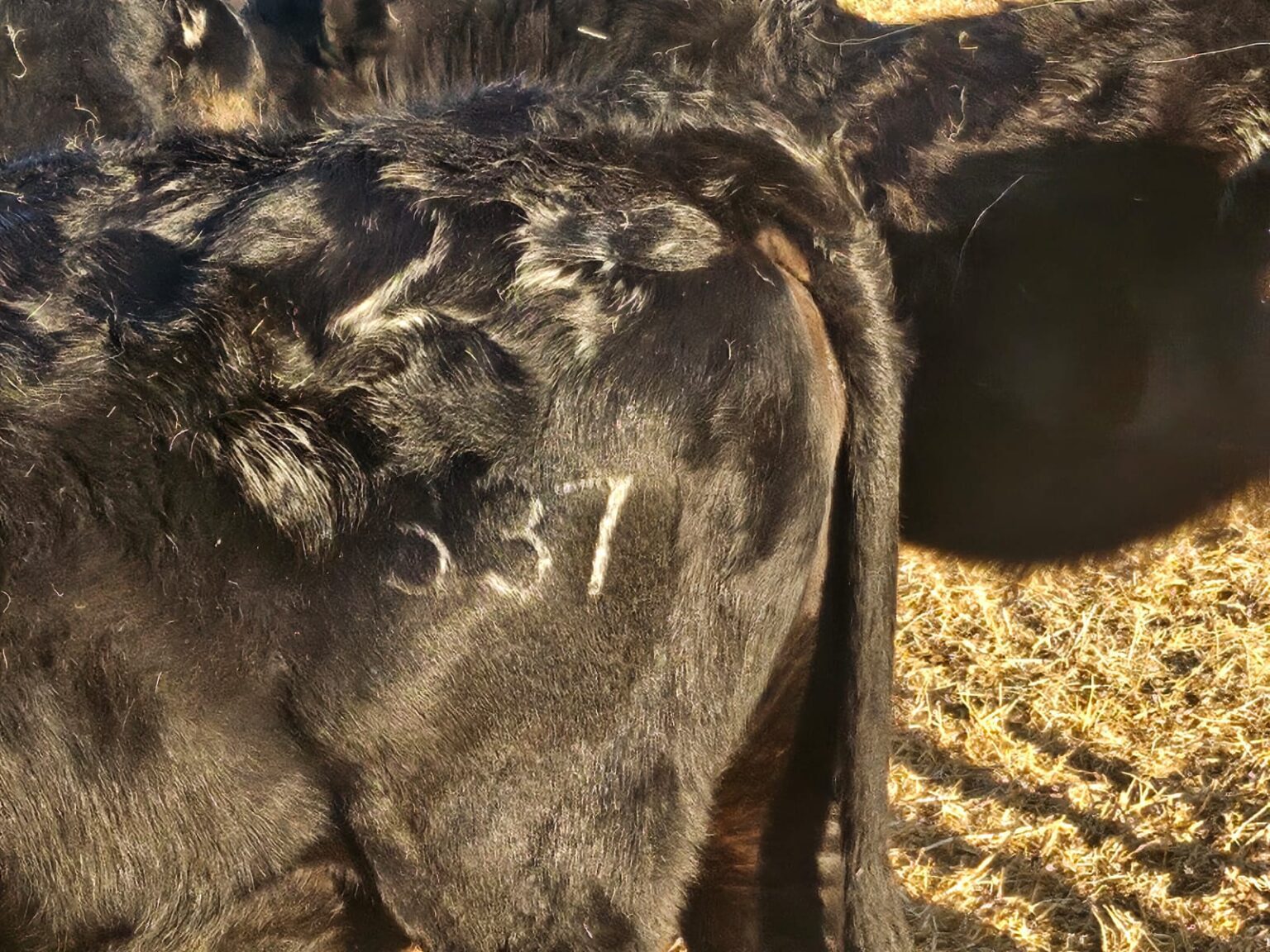
This photo clearly shows the mark on a younger animal in the early stages. You can see how the hair slowly begins to discolour and form a clear number.
Development of the mark over time
Petrus shows how the freeze-burn mark changes over time: from a slight discoloration in the first few days, to clear white hairs that begin to appear after a month, and is established as a permanent feature after three months.
Time saving and practical efficiency
Petrus has completely optimised the process from start to finish. He starts by shaving the part where the brand will be placed. Then he places the irons in an alcohol drip bath that has been cooled with dry ice. After about 30 minutes, the irons are cold enough to do the job.
“Each letter takes between 35 and 45 seconds, depending on the age of the animal. You burn one letter at a time, put it back in the ice bath, take the next one, and when you come back again the first iron is already cold enough,” explains Petrus. “It’s a rhythm that works well.”
Compared to hot branding, which only takes about 3 seconds per letter, it sounds slow, but the benefits outweigh the costs. “Being able to see a clear mark from a distance and not having to get up close actually saves you a lot of time later,” he says.
With the right handling facilities, one person can do the process themselves. But for larger herds, or where calves are being branded at a young age, it is advisable to use two to three workers in a small holding pen.
“Use the quieter times during the season when the calves are still small. Then you don’t have to do it during the busy weaning season.”
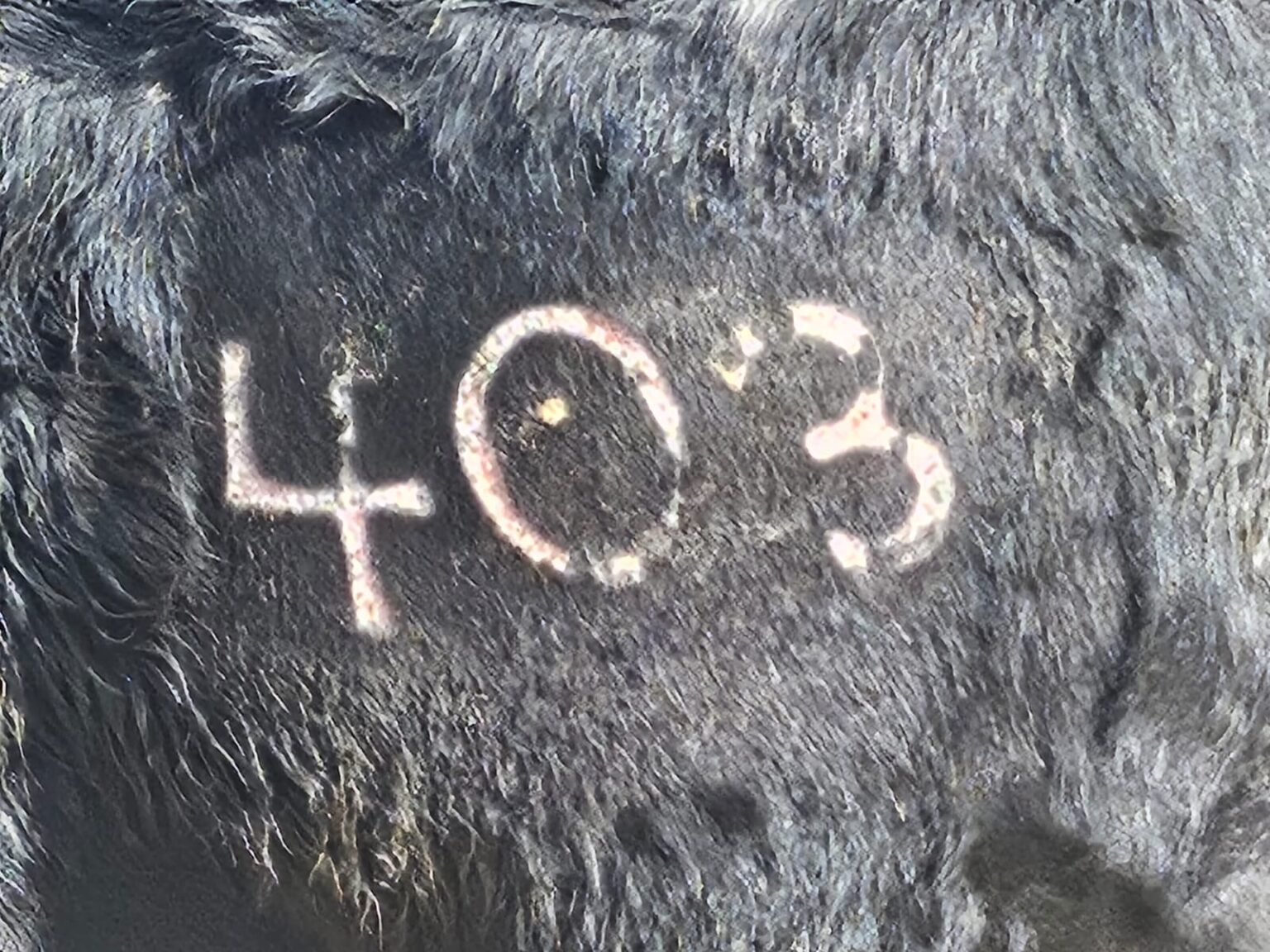
This is an animal with a freshly completed mark. Perfectly placed and easily readable, thanks to proper preparation and timing.
Cost and consumption
In terms of cost, the method is entirely feasible – even at scale. Marking 100 cattle with an ID and year (five letters) in one day is quite possible with the right equipment. For such a session, Petrus uses between 20 and 40 kg of dry ice, and about 4 litres of alcohol.
“There is a cost saving on larger herds, because you use up the dry ice. With smaller herds you may end up with leftovers, but with smart planning it is no problem,” he says.
He further explains that, once you have marked most of your herd, you only need to brand your replacement animals in subsequent seasons.
Safety and practical advice
Although the use of dry ice is relatively safe if handled carefully, Petrus recommends that farmers still take basic precautions, especially regarding skin protection. “We have never had any injuries, even though we have been using it without gloves for years. But gloves are advisable,” he says.
In addition to practical efficiency, freeze branding also brings a social benefit. The mark is clear enough that even a neighbour who drives by daily can memorize it. This helps with traceability and protection against theft.
“But that’s also a disadvantage,” laughs Petrus. “You can’t just drop off a weak calf at the auction, because everyone will immediately see that it’s yours!”
To find out more about how Dry Ice 4 Farming can help you tag your herd efficiently and more animal-friendly, visit their website or send an email to cynthia@dryice.co.za or call them at (+27)78-164-1712.