

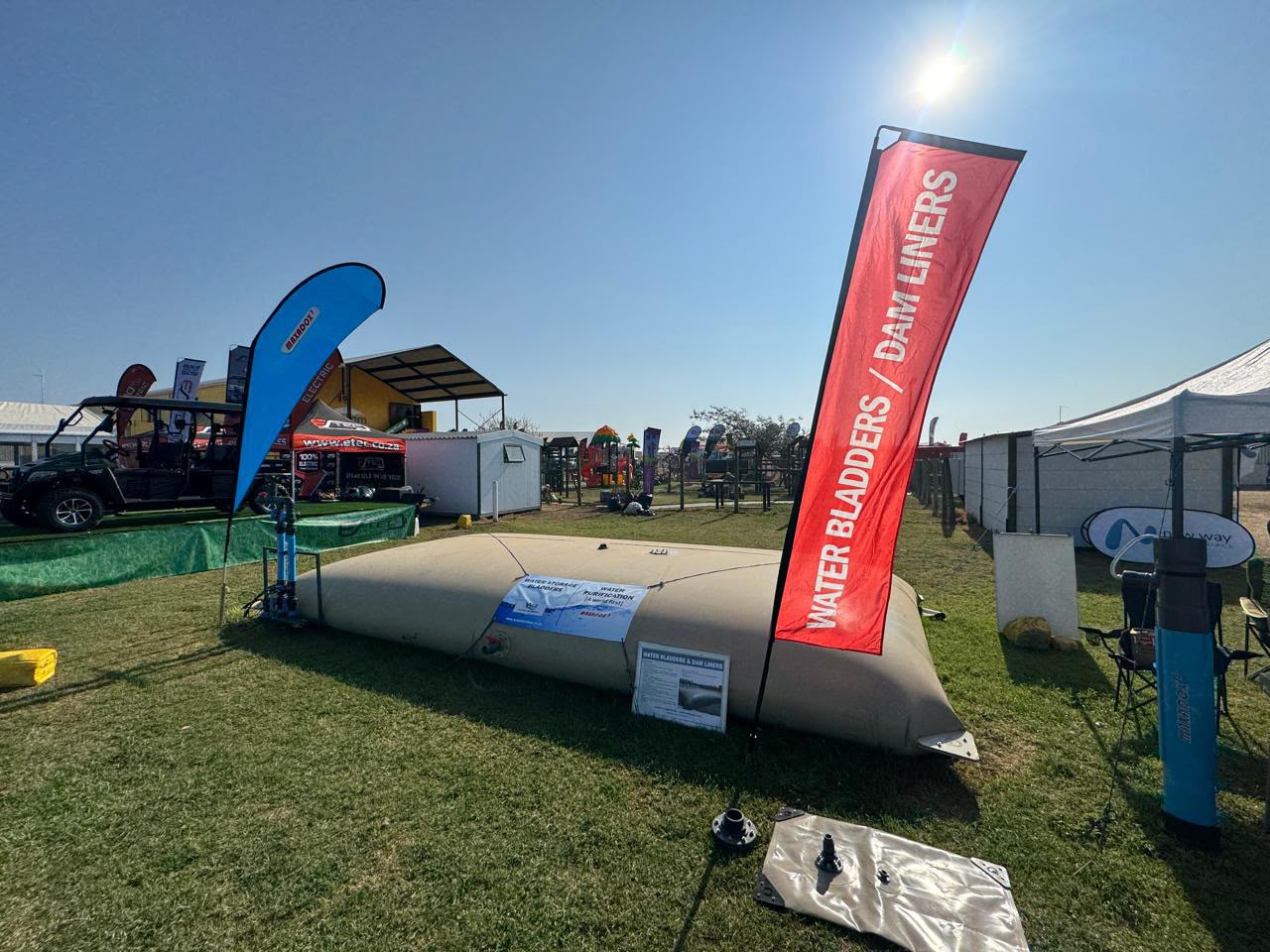
Water bladders are more than just convenient ways to store water for your farm, they are the perfect solution when you need long-term water storage. Silver Solutions, Water Bladders and Dam Liners owner Simon Cotton explained how remarkable these bladders are at this year’s NAMPO Cape.
He said that farmers are conservative in their choice of solutions, preferring traditional options like tanks, concrete dams or earth dams. However, these have known vulnerabilities, such as cracking and evaporation.
“Economically speaking, you can get a water bladder at a much more affordable price. A 520 000-litre bladder sells for R169 000 excluding VAT. That’s only 38 cents a litre, which, combined with the 10-year warranty, makes it the most economical choice.”
He also explained that transporting a water bladder is easier. When empty, even a large bladder that can store up to 520 000 litres only takes up around 1,5 m³.

Water bladders must be kept on level ground to prevent water from leaking from the overflow valve at the top.
Water bladders can be installed on any flat ground
One of the key advantages of any water bladder is that it can be installed virtually anywhere. If there is flat ground, the system can be deployed, which means the water can be stored where it is needed.
While the water bladder can be placed on rougher ground, Simon recommended laying down a layer of building sand to cushion the system. This ensures the ground is even and prevents rocks from damaging the liner over time.
“It is important to get the ground 100% level. Otherwise, the Water Bladder will start overflowing from the overflow valve, which sits at the very top of the bladder. The ground must also be clean. We don’t want to put a bladder on gravel because, eventually, that gravel will work its way into the bladder.”
However, he explained that once the bladder is in its location, it can be filled with water and left as is. The lining is a unique mixture of PVC that is imported from Germany; it contains a UV stabiliser that prevents the plastic from breaking down.
Simon concluded that one of the most important things to remember is that the plastic does not heat up over time. If there is water in the bladder, it touches all sides and absorbs heat, preventing the bladder from heating up in the same way other plastic or metal containers may.
If you want to learn more about Water Bladders you can contact Simon at 082-495-7997 or visit their website at www.waterbladders.co.za.


