It cannot fly, has only two toes on each foot, swallows stones with its food and lays an egg containing roughly the equivalent of 24 chicken eggs.
This is certainly no ordinary bird! The ostrich (Struthio camelus) is the largest and heaviest living bird in the world and is perfectly adapted to life with its feet firmly planted on African soil. What it lacks in flying ability, it makes up for in speed, strength and a few rather unusual characteristics.
A large frame and an even bigger personality
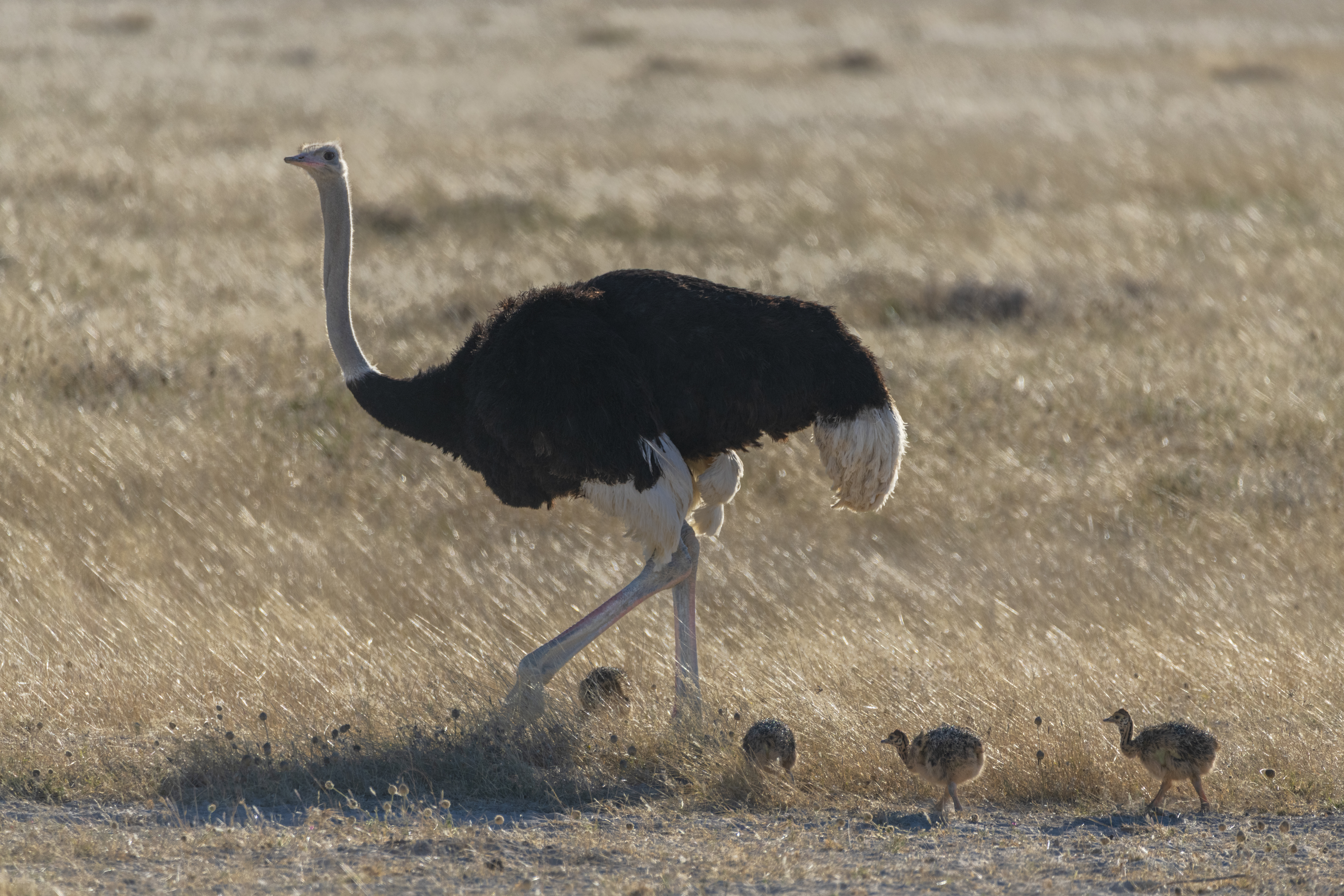
An adult male ostrich can stand approximately 2,7 metres tall and weigh more than 140 kg. Males are easily recognised by their striking black-and-white feathers, while females generally have more subdued greyish-brown plumage. And then there are those eyes! An ostrich’s eye measures approximately 5 cm in diameter and is larger than its brain. These enormous eyes, combined with its long neck, give the bird excellent vision across open plains and help it detect danger from a distance. Interestingly, its scientific name, Struthio camelus, refers to the “camel bird”. Like a camel, the ostrich is well adapted to hot, dry environments and can tolerate high temperatures and limited water availability.
If you cannot fly, run!
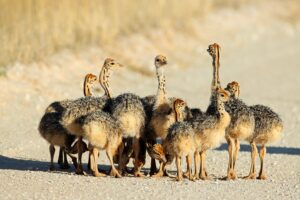
With such a large body, taking flight simply is not an option. Fortunately, the ostrich has another impressive talent. It is the fastest bird on land and one of the fastest animals on two legs. An ostrich can reach speeds of approximately 70 km/h during a sprint and maintain speeds of around 50 km/h over longer distances. Each stride can cover several metres. Even the youngsters waste no time. At approximately one month old, an ostrich chick can already run at surprisingly impressive speeds.
Only two toes?
Next time you see an ostrich, take a closer look at its feet. Unlike most birds, which have three or four toes, an ostrich has only two toes on each foot. The larger inner toe has a strong claw, and this unique foot structure helps the bird run efficiently at high speeds. However, those powerful legs are not just for running away. When cornered or threatened, an ostrich can deliver an extremely powerful forward kick. Combined with its strong claw, this makes its legs a formidable defensive weapon against predators.
No, it does not bury its head in the sand!
This is probably the most famous myth about ostriches: when they become frightened, they supposedly bury their heads in the sand. This is simply not true. When an ostrich cannot escape danger by running away, it may lie low against the ground and stretch its long neck out flat. From a distance, its head and neck can blend into the ground, creating the illusion that the bird has buried its head. Ostriches therefore do not bury their heads in the sand to ignore their problems – although we certainly enjoy using that expression to describe people!
An egg like no other
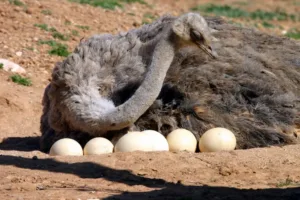
As the world’s largest bird, you would hardly expect an ostrich to lay a tiny egg. An ostrich egg can weigh more than 1,5 kg, with contents roughly equivalent to those of 24 chicken eggs. The ostrich egg is also often described as the largest single cell in the animal kingdom. When ostrich chicks hatch, they are already almost as large as an adult chicken. From there, they grow incredibly quickly and can approach their adult size within approximately six months.
No teeth? No problem!
Ostriches are omnivores and make use of whatever food their environment provides. Their diet can include plants, seeds, fruit and insects, as well as small animals when the opportunity arises. But how do you chew your food without teeth? You let stones do the work! Ostriches swallow small stones and gravel, which help grind food in their muscular gizzards. Their digestive systems are well adapted to extracting as much nutrition and water as possible from their food – an important advantage when living in the dry regions of Africa.
Feathers without a raincoat
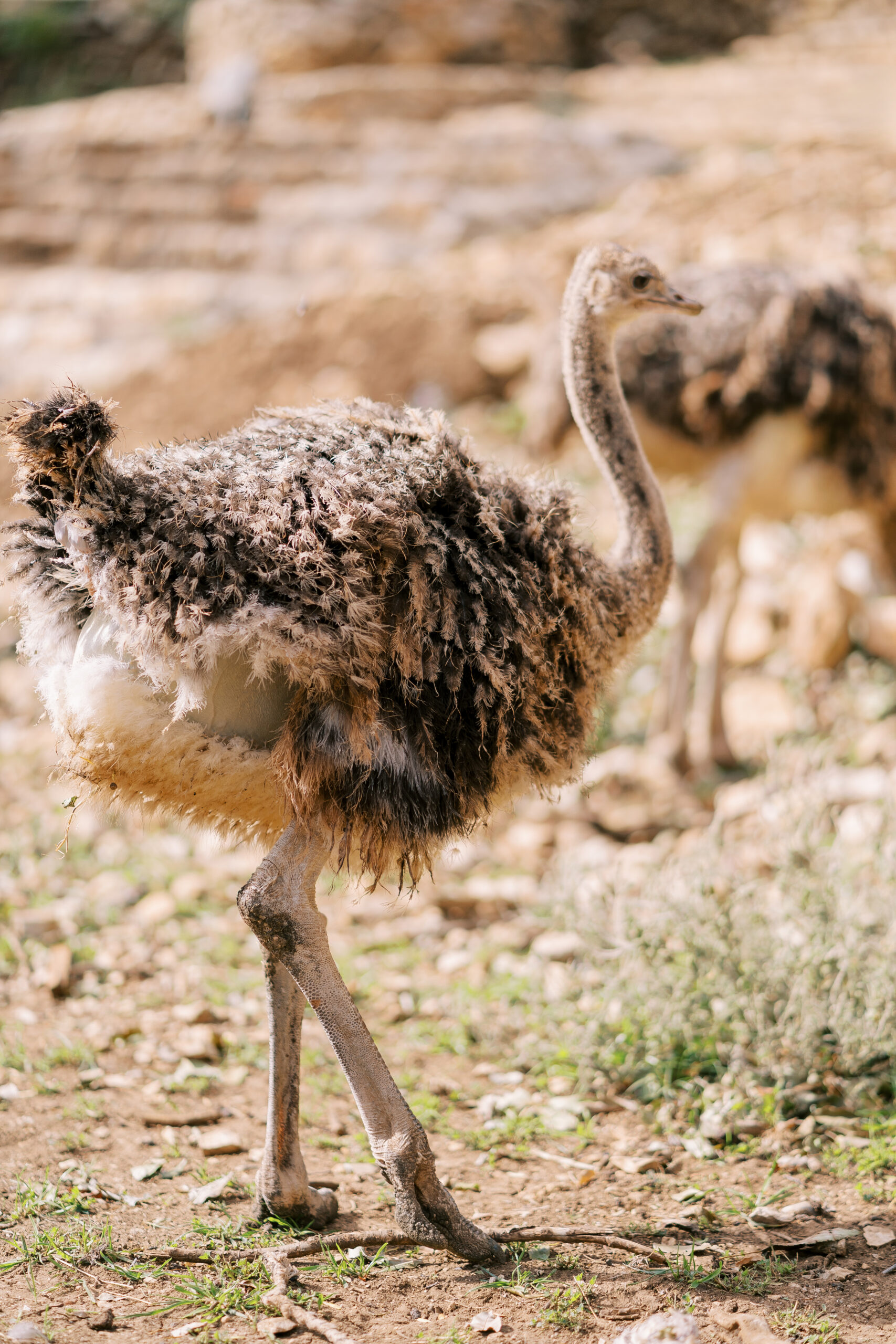
Another interesting difference between ostriches and many other birds is their feathers. Ostrich feathers have a looser, softer structure and do not provide the same waterproof covering found in many flying birds. This gives ostriches their distinctive fluffy appearance – and after a good downpour, those feathers can look particularly untidy!
Did you know?
• The ostrich is the largest and heaviest living bird in the world.
• It can sprint at approximately 70 km/h.
• Ostriches are the only living birds with just two toes on each foot.
• An ostrich’s eyes are larger than its brain.
• One ostrich egg contains approximately the same amount as 24 chicken eggs.
• Because ostriches have no teeth, they swallow small stones and gravel to help grind their food.
• They are exceptionally well adapted to surviving in Africa’s hot, dry regions.
A true South African favourite
From its enormous eyes to its unusual two-toed feet, very little about an ostrich could be considered ordinary. This bird does not need to take to the skies to be impressive. With its long legs, remarkable speed and ability to survive in some of Africa’s hottest and driest regions, it has found its own way to thrive. So, the next time an ostrich watches you from behind a fence, remember: Those big eyes belong to a bird that could probably outrun you with ease – and on just two toes, no less!
Sources
Fact Retriever. 24 Amazing Ostrich Facts You’ll Love. https://www.factretriever.com/ostrich-facts
15 Fun Facts. 15 Fascinating Facts About the Ostrich. https://15funfacts.com/ostriches
Fact Animal. 19 Outstanding Ostrich Facts. https://factanimal.com/ostrich/
The Fact File. 50 Interesting Facts About Ostriches. https://thefactfile.org/facts-about-ostriches/