Every harvest begins with a seed. Yet the difference between a profitable season and a failed one is often determined not in the field, but in the hours before planting, when a seed is either properly conditioned or it is not. Across global agricultural markets, the science of seed conditioning has evolved from a niche processing step into one of the most commercially and agronomically significant practices in modern crop production.
For Southern African producers and seed manufacturers, companies like Kannar Earth Science have been providing the technical solutions to close the gap between a seed’s genetic potential and its realised yield.
Seeds are the foundation of agriculture, and without a steady supply of high-quality seed, yields and crop quality would be greatly diminished (NC State Extension, n.d.). This is not a contested point. What is less well understood, particularly among smaller-scale producers, is that seed quality is not simply a function of genetics.
In its simplest form, conditioning is the process of cleaning the seed and removing impurities and contaminants so that the end user receives pure, high-quality seed ready for planting (Crop Trust, n.d.). But modern seed conditioning extends far beyond cleaning. It encompasses polymer coating, fungicidal protection, micronutrient application, and the physical preparation of seed for mechanical handling, all of which have measurable effects on crop establishment and final yield.
The market reflects this understanding. The global seed treatment market was valued at approximately USD 9,98 billion in 2024 and is anticipated to reach USD 24,06 billion by 2033, growing at a compound annual growth rate of 10,27% (Market Data Forecast, 2025). Within Africa, growth is particularly notable, with South Africa accounting for nearly 33% of the African seed treatment market in 2024 and demonstrating robust growth potential with an expected annual growth rate of approximately 5% through to 2029 (Mordor Intelligence, 2025).
The Middle East and Africa region as a whole is projected to grow at over 7% annually through 2030, driven by increasing food security pressures, evolving regulatory frameworks, and a growing awareness among commercial producers of what properly conditioned seed can deliver (Research and Markets, 2025).
The urgency behind these figures is not merely commercial. Climate change is expected to have a more pronounced effect during the early stages of plant development, particularly germination and seedling establishment, than at later growth stages, and reduction in seed vigour has been shown to detrimentally impact the uniformity, growth, development, and yield of crops including soybean (Née et al., 2024).
Under increasingly variable rainfall and temperature conditions, the seedbed has become a more hostile environment. Robust, well-conditioned seeds with measurably higher vigour are no longer a luxury. They are a practical necessity for stand uniformity and weed suppression, two of the most direct routes to reduced input costs. Successful stand establishment is also important for forming a crop canopy, which reduces weed growth and therefore herbicide usage (Née et al., 2024).
Kannar Earth Science has been producing seed polymers since the 1990s, establishing a depth of formulation experience that is directly relevant to these challenges (Kannar Earth Science, 2025). At the core of the Kannar seed conditioning range is the Seedkote polymer system, which addresses three interconnected problems that affect almost every commercial seed operation: treatment adhesion, dust-off risk, and planter performance.
Polymers help active ingredients such as natual or synthetic actives, biologicals, and inoculants bind reliably onto the seed, resulting in less dust-off and abrasion. The opptomised binding, maximises the effectiveness of treatments while increasing their sustainability (Michelman, 2025). When actives are poorly bound to seed, they are lost through abrasion during handling, bagging, transport, and planting. This means the treatment rate applied at the processing facility is never fully delivered to the soil. The farmer pays for full-rate protection but receives a fraction of it. Kannar’s Seedkote polymers are designed to prevent exactly this loss by providing superior adhesion of active ingredients to the seed surface (Kannar Earth Science, 2025).
Film coating vastly reduces harmful dust from treated seeds while producing a smooth surface so that seeds flow easily through processing and sowing equipment (Germains Seed Technology, n.d.). The ecological and occupational health dimension of this is significant and is increasingly scrutinised by regulators. Treated seed dust containing fungicide and insecticide residues presents an exposure risk for workers in processing facilities and on-farm during planting. A well-formulated polymer that minimises dust-off simultaneously reduces the regulatory and liability exposure of the seed company and the health risk to the operator. Kannar’s Seedkote range is explicitly designed to meet this dual standard, providing excellent binding performance while delivering the optimised slip characteristics that ensure consistent seed flow through planters and air seeders (Kannar Earth Science, 2025).
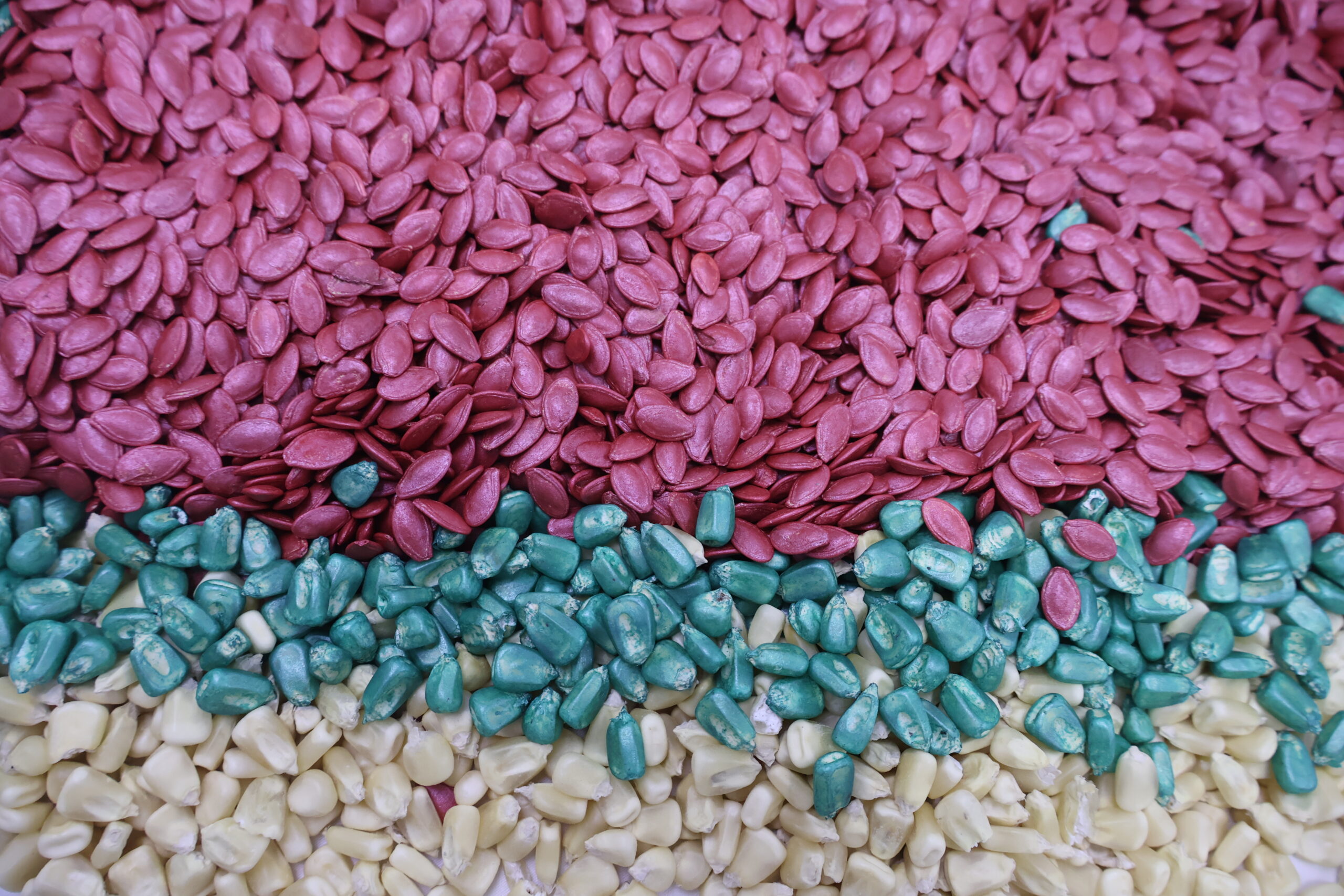
The visual effect of seed conditioning is more than cosmetic. A clear distinction between treated and untreated seeds ensures compliance with regulatory standards and reduces the risk of accidental mixing during planting and throughout the supply chain. The Seedkote range includes a variety of high-impact colour options that serve this compliance function while also supporting the commercial presentation of treated seed products. For seed companies, the appearance of a finished, uniformly coated seed is a direct marker of processing quality and a commercially meaningful differentiator at point of sale (Kannar Earth Science, 2025). Seed colour is imporant as marketing tool differentiate brands, varieties and genetics. Visibility of seed is key on the farm where a seed “pops” from easy identification from the surrounding soil.
Alongside its polymer technology, Kannar produces Kanmol 500, a high-dose Sodium Molybdate formulation available in both liquid and granular form, designed to work in combination with its polymer range or as a standalone product (Kannar Earth Science, 2025). Molybdenum is among the most agronomically consequential of the trace elements, and its deficiency is widespread in Southern African soils, particularly in acidic conditions. Molybdenum is unique among micronutrients in that it is required in the smallest quantity of any essential element, yet without it, the entire nitrogen cycle in plants breaks down (Cropaia, 2024).
The practical significance of this for legume producers cannot be overstated. In leguminous crops such as soybeans, peas, and alfalfa, the bacteria in the root nodules require molybdenum to activate the nitrogenase enzymes, facilitating the conversion of atmospheric nitrogen into ammonia, a form of nitrogen that plants can readily assimilate (Greenway Biotech, n.d.). Where molybdenum is deficient, nitrogen fixation efficiency collapses, and producers who intended to capture the full benefit of biological nitrogen fixation instead face nitrogen deficiency symptoms that may be misdiagnosed as poor inoculation or soil fertility failure. The downstream effect is either unnecessary synthetic nitrogen application or reduced yields, neither of which is commercially acceptable in a tight-margin cropping system.
Seed treatment is one of the most efficient delivery mechanisms for molybdenum, providing season-long protection for annual crops from a single application at planting, and it is especially critical in acidic soils where molybdenum availability drops dramatically with each decrease in pH (Mikkelsen and Camberato, 2015). Research has quantified the yield response. A study published in the International Journal of Plant Production found that seed priming with sodium molybdate increased chickpea yield by 27% in pot conditions and 20% in field conditions (Farook et al., 2012, cited in Mikkelsen and Camberato, 2015). Applied at the seed level, Kannar’s Kanmol 500 formulations allow producers to address molybdenum deficiency precisely, efficiently, and cost-effectively, without the need for separate foliar or soil applications (Kannar Earth Science, 2025).
Kannar Captan FS, is traditional a registered flowable concentrate fungicide formulation applied to maize, wheat, cotton, sorghum, and vegetable seeds (Kannar Earth Science, 2025). Seed-borne and soil-borne fungal pathogens represent one of the most consistent yield threats across all major cropping systems. Captan has been used as a seed treatment since the 1950s to protect seeds against a variety of fungal pathogens, inhibiting fungi from entering plant tissue (Albaugh, n.d.). Its long record of use reflects both its broad-spectrum efficacy and its well-understood mode of action. Captan is also active against certain oomycetes such as Pythium, making it particularly useful for controlling damping off (Lamichhane et al., 2021). Damping off is among the most economically damaging seedling diseases encountered in commercial production, capable of eliminating plant stand in patches or across entire paddocks under wet, cool conditions.
The fungicidal protection delivered by Captan FS at planting is particularly relevant for early-season cropping under conditions where cool, wet soils slow germination and extend the window of seedling vulnerability. If crops are planted early into cool, wet soils, seed treatments can offer several weeks of protection against soil-borne pathogens and insects if germination is delayed (WinField United, 2025). By applying Captan FS to seed before it enters the bag, producers pre-position their crop with a protective fungicidal barrier that is active precisely at the moment of greatest biological need.
The Kannar seed conditioning range addresses problems that are both universal and relevant. Seed polymers solve an efficiency problem: the loss of expensive active ingredients through abrasion and dust-off. They also mitigate a safety problem through reduced operator exposure to treated seed particulates. Kanmol 500 solves a nutritional deficiency problem that is particularly acute in the acidic soils characteristic of parts of Southern Africa, where molybdenum availability is naturally compromised. And Captan FS solves a disease management problem that directly threatens plant stand and the investment represented by every hectare of planted crop.
From resource-poor to industrial-scale farming, high seed quality is essential for crop production to be both sustainable and profitable, and is therefore widely accepted as a critically important agronomic trait (Oxford Academic, 2016). The decisions made at the processing stage, about which polymers to use, whether molybdenum is applied, and what fungicidal protection is in place, have yield consequences that unfold across the entire growing season. Kannar Earth Science, with over three decades of formulation experience and a product range designed to address these decisions in an integrated way, is positioned as a practical partner for the South African seed and agriculture sectors at a moment when the performance of every seed matters more than ever.
References
Albaugh (n.d.) Captan 4L ST seed applied fungicide. Available at: https://www.albaugh.com/us/agriculture/crop-protection/seed-treatment/fungicides/listings/captan-4l-st [Accessed 19 March 2026].
Crop Trust (n.d.) Seed conditioning 101: basic foundations. Available at: https://www.croptrust.org/knowledge-hub/genebank-academy/course/up-seed-conditioning-101-basic-foundations/ [Accessed 19 March 2026].
Cropaia (2024) Molybdenum matters: how to enhance crop performance. Available at: https://cropaia.com/blog/molybdenum-in-plants-and-soil/ [Accessed 19 March 2026].
Farook, M.A., Hussain, M., Wakeel, A. and Siddique, K.H.M. (2012) ‘Seed priming with sodium molybdate improves germination and early seedling growth in chickpea’, cited in Mikkelsen, R. and Camberato, J. (2015) ‘Potassium, sulfur, lime, and micronutrient fertilizers’, in Soil Fertility Management in Agroecosystems. Madison: American Society of Agronomy.
Germains Seed Technology (n.d.) Seed film coating. Available at: https://germains.com/product-category/seed-filmcoating/ [Accessed 19 March 2026].
Greenway Biotech (n.d.) Sodium molybdate fertilizer. Available at: https://www.greenwaybiotech.com/products/sodium-molybdate [Accessed 19 March 2026].
Kannar Earth Science (2025) Seed conditioning. Available at: https://kannar.co.za/seed-conditioning/ [Accessed 19 March 2026].
Lamichhane, J.R., Bourgeois, T., You, M.P., Barbetti, M.J. and Aubertot, J.N. (2021) ‘Seed treatment with systemic fungicides: time for review’, Frontiers in Plant Science, 12, art. 654512.
Market Data Forecast (2025) Global seed treatment market size, share, trends and growth forecast report 2025–2033. Available at: https://www.marketdataforecast.com/market-reports/global-seed-treatment-market [Accessed 19 March 2026].
Michelman (2025) NurtureYield seed coatings and treatments. Available at: https://www.michelman.com/solutions/nurtureyield/ [Accessed 19 March 2026].
Mikkelsen, R. and Camberato, J. (2015) ‘Potassium, sulfur, lime, and micronutrient fertilizers’, in Soil Fertility Management in Agroecosystems. Madison: American Society of Agronomy.
Mordor Intelligence (2025) Seed treatment market size and share analysis. Available at: https://www.mordorintelligence.com/industry-reports/seed-treatment-market [Accessed 19 March 2026].
NC State Extension (n.d.) Seed and seed quality. Available at: https://content.ces.ncsu.edu/seed-and-seed-quality [Accessed 19 March 2026].
Née, C., Kramer, K., Nakabayashi, K., Yuan, B., Xiang, Y., Miatton, E., Leubner-Metzger, G. and Soppe, W.J.J. (2024) ‘Seed germination and vigor: ensuring crop sustainability in a changing climate’, PMC, National Institutes of Health. Available at: https://pmc.ncbi.nlm.nih.gov/articles/PMC9177656/ [Accessed 19 March 2026].
Oxford Academic (2016) ‘Seed vigour and crop establishment: extending performance beyond adaptation’, Journal of Experimental Botany, 67(3), pp. 567–591. Available at: https://academic.oup.com/jxb/article/67/3/567/2893341 [Accessed 19 March 2026].
Research and Markets (2025) Middle East and Africa seed treatment market outlook, 2030. Available at: https://www.researchandmarkets.com/report/middle-east-seed-treatment-market [Accessed 19 March 2026].
WinField United (2025) Why seed treatments are critical for crop success. Available at: https://www.winfieldunited.com/news-and-insights/why-seed-treatments-are-critical-for-crop-success [Accessed 19 March 2026].