Fish farming is an integral part of profitable farming in Zambia and makes an important contribution to economic, social health and well-being in the country. Fish is a good source of protein in any diet, and Tiger Animal Feeds plays a key role in the country’s fish farming industry by manufacturing quality fish feed.
For fish farming to contribute meaningfully to the national economic cycle, a need exists for a viable and reputable fish feed manufacturer. This is where Tiger Animal Feeds comes in. Tiger Animal Feeds is committed and focused on providing technical service not only existing but also potential fish farmers, while also producing quality fish feeds that promote faster growth.
Key points to considered when engaging in fish farming:
Water quality
Fish need good water quality to survive and grow. The water should have no pollutants, a high level of dissolved
oxygen, and should not contain excessive organic or toxic matter. A vegetated barrier is needed to reduce soil erosion and pesticides entering the pond.
Notes:
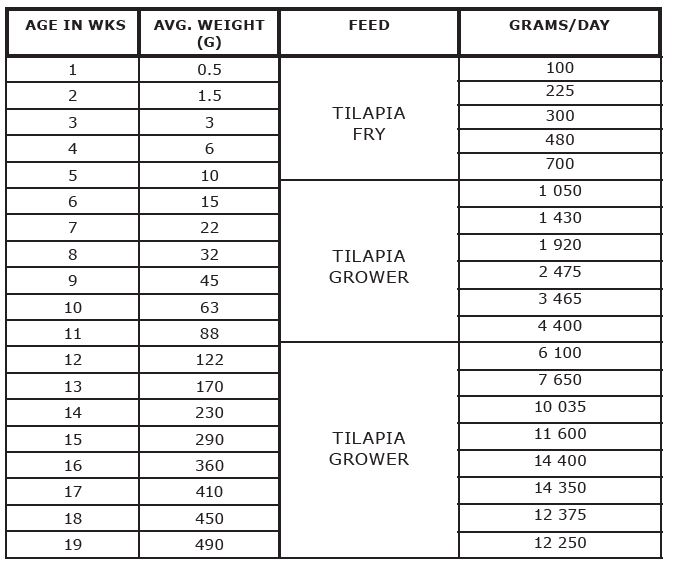
1.Average growth = 4,5 g/day overall
2.Expected Feed Conversion Rate (FCR): 1,3-1,4:1 max FCR 1,55:1
3.Feed five times per day
4.Feed should be fresh, dry and kept out of sunlight
5.Feed buckets should be kept clean and dry
6.Keep modules clean – remove excess feed and dead fish daily
Record keeping
Keep accurate records of the numbers and sizes of fish caught in the pond, as these will determine the evaluation and fish population status or whether any management is needed. Record the feed consumption, feeding period, water quality, fish mortality, fish weekly weights and size. Periodically review your records to see if there are any differences with the standard parameters.
Stocking density
Stock the pond with all male fingerlings. The use of mixed sex tilapia is not recommended because:
•Males grow faster than females
•Mixed sex tilapia will start to reproduce after a few months. This reproduction process cannot be controlled.
•Uncontrolled breeding leads to poor growth of fish and other problems, such as diseases.
•It is important to source fingerlings from a well-trusted and recognised breeder, for optimum size and uniformity.
Mortality
Fish mortality affects the population. As drug treatments are expensive, fish mortality invariably leads to lower harvest and higher costs. Fish farmers often suffer hefty economic losses due to high mortality rates. To alleviate such losses, it is crucial to take precautions to prevent fish mortality. It is also important to prevent water quality from deteriorating due to high pathogen levels and other sources.
Regular monitoring of fish health is an effective way to prevent high mortality rates. One major cause of serious fish mortality is overlooking the contagious nature of fish diseases and thus delaying treatment.
For more information contact Rowena Blanco, Animal Nutritionist of Tiger Animal Feeds on (+260)977-991-847 or visit their website on www.tigerfeeds.com