A young Ugandan student has become the first to record how a deadly virus like Marburg, a close relative of Ebola, jump from the carrier animal to other animals and humans.
Bosco Atukwatse, a 25-year-old undergraduate working with Volcanoes Safaris Partnership Trust Kyambura Lion Project in Queen Elizabeth National Park in Uganda, has found the direct link between the bats living in Python Cave in Uganda, says Alexander Richard Braczkowski in an article published in The Conversation.
“For years, scientists studying how diseases spread from animals to humans have hypothesised that zoonotic diseases jump from a wildlife reservoir (like a bat) to an intermediate host (monkey) and potentially to us, humans.”
Yet Bosco, in a little more than four months, recorded on camera 261 predator encounters including leopards, pythons, Nile monitors, crowned eagles and blue monkeys feeding on the bats from this cave that is known for harbouring the Marburg virus.
Also, defying all logic, more than 400 humans, including tourists, were filmed, some ignoring a viewing platform 35 m away and wandering as close as two meters from the cave entrance without any protective wear.
What is the Marburg Virus
Marburg is a highly infectious zoonotic haemorrhagic fever transmitted to people from fruit bats, specifically the Egyptian Rousette bat (Rousettus aegyptiacus). It spreads among humans through direct contact with the bodily fluids of infected people, surfaces and materials.
Marburg virus is named after the town in Germany where it was first detected in 1967, when outbreaks at laboratories in Marburg and Belgrade in Serbia, then part of Yugoslavia, occurred, killing seven people. The virus was conveyed by African green monkeys (Chlorocebus sabaeus) imported from Uganda for use in experiments.
Several Marburg virus outbreaks have since occurred in Sub-Saharan Africa, including the Democratic Republic of Congo, Uganda and Tanzania, with an outbreak in Tanzania and Equatorial Guinee between February and June 2023 that killed six of nine patients. The first case of fatal Marburg virus disease in West Africa was identified in Guinea in August 2021.
Previous outbreaks occurred in Angola, where 300 people died in 2005, as well as Kenya and South Africa, but the South African was infected elsewhere, not in the country.
Rwanda is presently experiencing an outbreak with 46 cases recorded and 12 deaths so far; the source of the outbreak is still being investigated. Seven hundred doses of an experimental vaccine have just been shipped from the US to Rwanda. It is being administered as part of a clinical trial, mostly to healthcare workers, who have fallen victim to the virus so far.
Spillover interface observed
Disease ecologists have long known that major outbreaks often originate in wildlife, such as swine flu, avian flu and even SARS-CoV-2 that could all be traced back to animal hosts.
However, there were no direct observations of the spillover interfaces: The exact moments when a virus jumps from a bat, goose, or other animal into new species like humans, livestock or other wildlife.
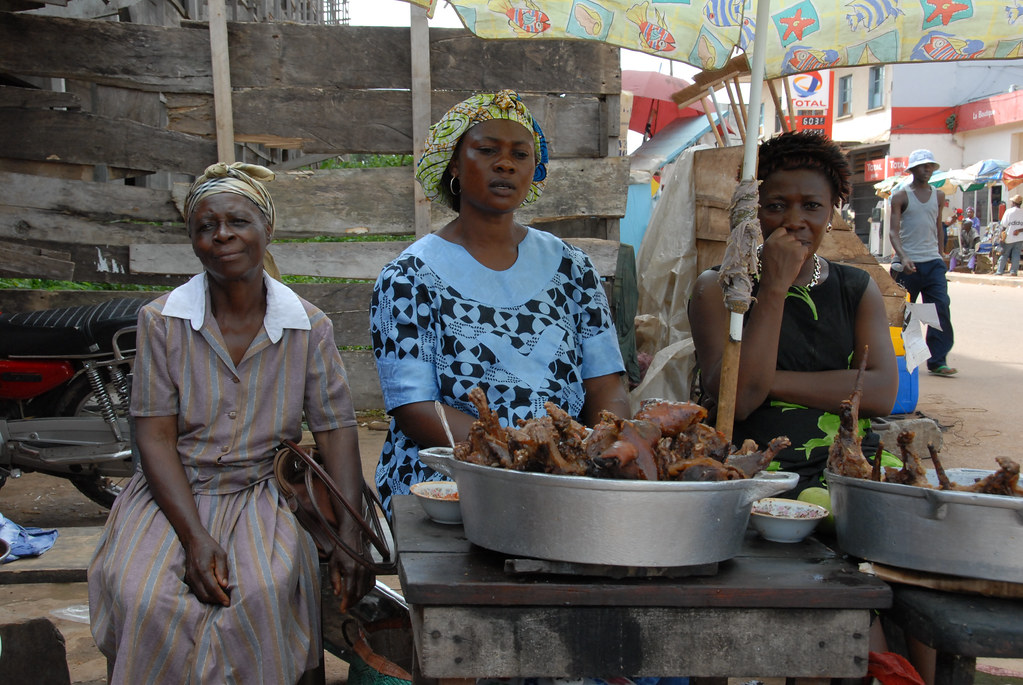
Bushmeat sold in the local market at Ebolowa, Cameroon, Africa. (Colince Menel/CIFOR https://www.flickr.com/photos/cifor-icraf/35893455154)
Zoonotic spillover
Zoonotic diseases that occur in animals and spill over into humans, will continue to emerge where a reservoir of host species occurs and where humans and wildlife come into contact.
In the case of Marburg, outbreaks typically occur when people come in contact with infected green monkeys, pigs or Egyptian rousette bats, all carriers of the virus.
Once the disease jumps from the infected animal to a human in a zoonotic spillover, it can spread from person to person through bodily fluids or by contact with contaminated surfaces like bedding.
The incubation period may last from five to ten days, when symptoms, including muscle pains, diarrhoea and vomiting will start.
The virus damages blood vessels and inhibits the blood’s ability to clot. This can lead to uncontrolled bleeding from the nose, eyes, gums, rectum and, in women, the vagina.
Besides the trial vaccine being used in Rwanda, there is no antiviral drugs to treat patients. They are kept hydrated and blood loss is replaced through transfusion.
Between 24 and 88% of people infected with Marburg virus die – usually through extreme blood loss and shock.
Marburg is not an airborne illness and is not thought to be contagious before symptoms appear. Yet, people can remain infectious for months after they have recovered and still pass the disease on through bodily fluids, so men are advised to wear a condom for a year after symptoms first appear.
Bushmeat and zoonotic spillover
While direct contact with bats that carry the Marburg virus, many other zoonotic diseases are caused by handling and eating of virus-carrying animals. These include HIV/AIDS, Ebola, mpox and even COVID, that may all have their origin in zoonotic spillover.
The World Health Organisation estimates that more than 70% of emerging diseases over the past three decades have been zoonotic, and many of these diseases were likely caused by butchering and eating bushmeat.
Bushmeat is the meat from wild land mammals that is used for human consumption, mainly in rural tropical and subtropical regions all over the world.
Bushmeat is hunted, slaughtered, sold, transported, cooked and eaten and all along the process, humans are in contact with highly infectious pathogens found in these wild animals. While the animals are not affected by the disease, it can be deadly to humans and other animals, which leads to local outbreaks, regional epidemics and worldwide pandemics.
West Africa and Central Africa are mostly associated with bushmeat activities. Where domestic livestock is scarce in countries such as Congo, the Democratic Republic of Congo, Gabon, the Central African Republic and Cameroon, bushmeat is an important source of food. The emergence of zoonotic diseases from this region where bushmeat is on the menu, emphasises the importance of monitoring bushmeat activities from an epidemiological perspective.
The diseases are not only transmitted by eating certain host species, but also from handling bodily fluids when slaughtering, processing and cooking. Scientists believe as human populations grow and encroach on natural habitats, the risk of disease spillover will likely increase.
Scientists are working on mapping bushmeat activities that could help predict the outbreak of zoonotic diseases at a global level. Targeted surveillance of these regions could help prevent zoonotic spillovers and increase the preparedness for global zoonotic disease outbreaks.
Source references
Braczkowski, A.R., (2025) How does Marburg virus spread between species? Young Ugandan scientist’s photos give important clues
Didharthan, C. (2023) Global mapping of bushmeat activity to improve zoonotic spillover surveillance
Kinard, J. (2023) Map of Bushmeat Consumption Reveals Pandemic Risks. Unregulated wild animal markets increase the risk of more epidemics
https://www.scientificamerican.com/article/map-of-bushmeat-consumption-reveals-pandemic-risks/
Markotter, W. (2021) The first human case of Marburg virus in West Africa is no surprise: here’s why
Mohammed, M. (2024) Marburg virus outbreak in Rwanda – what you need to know https://theconversation.com/marburg-virus-outbreak-in-rwanda-what-you-need-to-know-240252