Clavibacter nebraskensis (Clavibacter michiganensis subsp. nebraskensis)
International common names: Leaf Freckles & Wilt or Nebraska Leaf Freckles & Wilt
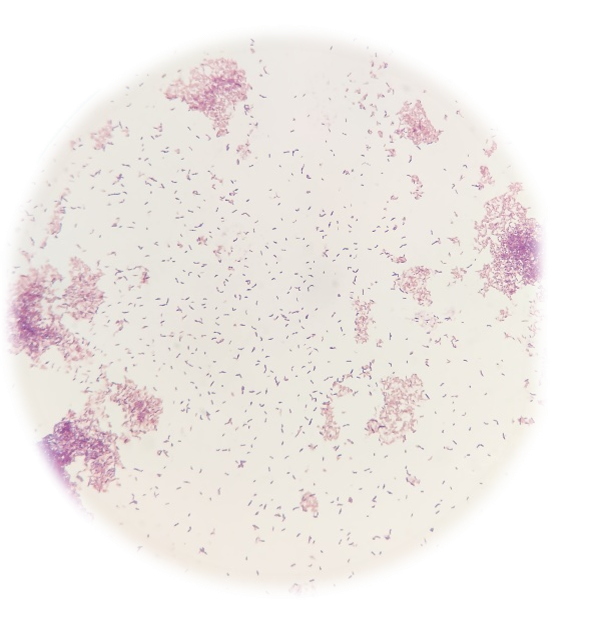
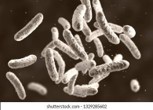
- Microscopic – small rod-shaped cells
- Gram-positive – orange pigmented
- Non-motile
- In pairs or short chains

Mostly confused with:
- Northern Corn Leaf Blight (Exserohilum turcicum)
- Sunburn Damage / Heat Stress
- Diplodia Leaf Streak (Stenocarpella macrospora)
Identification
- Field symptoms
- Lab identification through:
- Microscopic identification
- ELISA (enzyme linked immunosorbent assay)
- Lab identification through:
- DNA
Impact
- Reduces maize seedling vigour, plant populations, stalk & grain quality and yield.
- Yield loss due to the leaf blight, loss of green (photosynthetic) area and premature death.
- Most severe impact occurs in the year following a Goss’s Wilt infection because of the increased amount of inoculum in residue.
- Timing of leaf blight infection has a critical role in Goss’s Wilt yield reductions. Early infections lead to the greatest yield loss (50%), whereas late infections often have little yield effect.
- Stalk lodging due to leaf area loss.
- Goss’s Wilt doesn’t produce toxins – plant material and grain are safe for animal and human consumption.
- Phytosanitary Impact – Seed Trade.
Distribution & spread
- Initial introduction into a new region possibly through seed – seedborne and seed transmitted.
- Secondary spread through wind and rain splash.
- Besides maize and sweetcorn, Goss’s Wilt can infect sorghum, Sudan grass, sugarcane, wheat and various grasses.
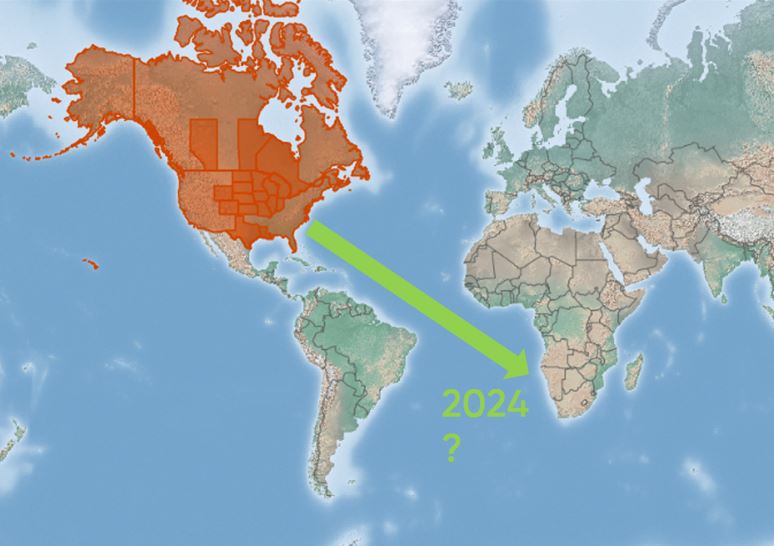
- Goss’s Wilt is a bacterial disease that originated in Nebraska, USA, in 1969, but in recent years has moved east across the corn-belt. It has been confirmed in upper mid-west corn-belts, which includes western Canada.
- Goss’s Wilt suspected and confirmed by some stakeholders in South Africa in 2024.
Fine dry leaf matter with bacterial exudate exited, combines in dust clouds and carries the bacteria particles in winds to new uninfected fields.
Symptoms & signs
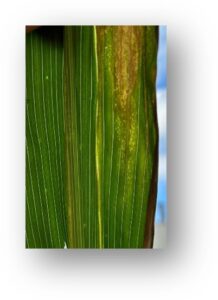
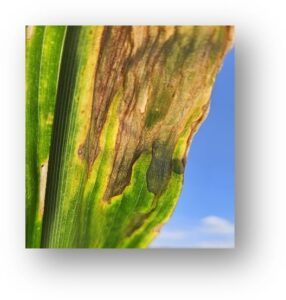
- Early leaf symptoms are oblong or elongated lesions of water-soaked, greyish-green tissue that progress to long, dead streaks.
- Freckles – dark green to black water-soaked spots – often near lesion edges.
- Shiny exudate (bacteria ooze) on the leaf surface and may appear shiny after drying, to form a glistening residue or varnish within the lesion.
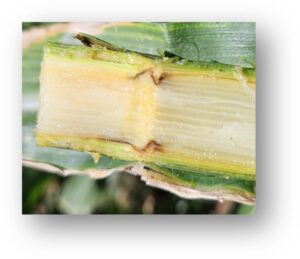
- Plants may also be infected systemically by Goss’s Wilt, especially in the seedling stage. These plants have discoloured vascular tissue with a slimy bacterial exudate in the stalk.
- Plants are commonly stunted and wilt and die, as if drought-stressed.
- Seedlings and early V-stage plants may acquire the bacteria systemically by hail damage or sandblasting.

Life cycle
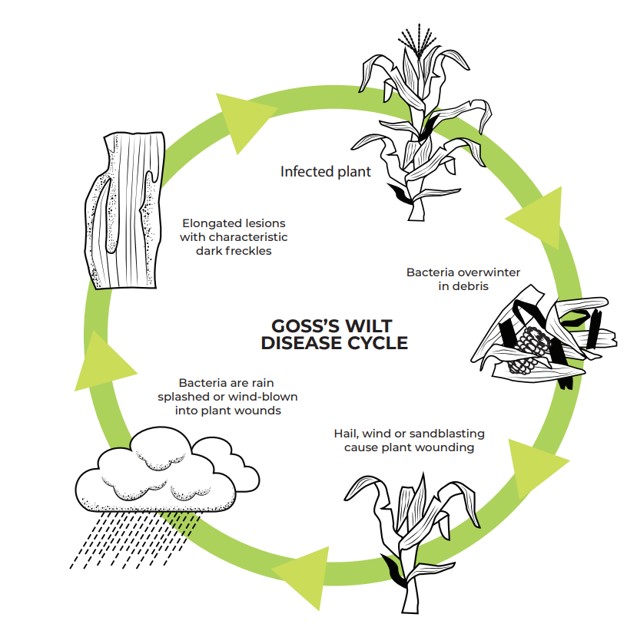
- Bacterial invasion requires an injury to the plant.
- Plants wounded from wind, sandblasting and especially hail, provide openings for bacteria.
- Infection is spread through the canopy by rain splash, irrigation and wind.
- Goss’s Wilt overwinters in residue of maize and several grass species.
- Maize plants are at the greatest risk of yield loss at early grain fill under severe leaf blight pressure.
- Insects are not known to be a factor in spread or development of this disease.
- Wet weather and high humidity encourage development.
- There are two phases of the disease:
- Systemic wilt (less common)
- Later season foliar blight
Disease management
Genetic resistance:
- Primary management method.
Reduce corn residue:
- Disease can become problematic in maize-on-maize, high-residue fields.
- Crop rotation is effective in reducing residue (e.g., soybeans and sunflower).
- Crop rotation with non-host crops (e.g., soybeans and sunflower).
- Tillage encourages residue breakdown.
Control grassy weeds:
- Weeds host the disease bacteria.
- Green foxtail, barnyard grass, shatter cane, among others.
Prevention/avoidance:
- Harvest and till affected fields last, and clean equipment to avoid spreading the pathogen to uninfected fields.
- Planting uncontaminated seed in the areas with no history of the disease will prevent the spread of the pathogen over long distances.
Fungicides are NOT effective.
Goss’s Wilt is caused by a bacterium, not a fungus.
No known fungicide or seed treatments are effective. Contact Pioneer Seed at info.rsa@pioneer.com with any questions or if more information is required.