When you drive past Zoutpansdrift near Douglas in the Northern Cape at the end of winter, you’ll notice beautiful green lucerne lands. This is where Hein Mulke farms with, among other crops, lucerne under irrigation.
Lucerne isn’t just an excellent source of protein, fibre and vitamins for animals, it’s also very good for soil health. The deep root system of this perennial legume crop helps to improve soil health, which is advantageous for follow-up crops.
Limagrain’s lucerne makes the difference
Zoutpansdrift is one of four farms in South Africa that has already discovered the secret behind Limagrain’s Field Seeds. By mixing two of their most popular lucerne cultivars, Zoutpansdrift and other farms ensure that they achieve a good yield, gain resistance against most plant diseases, and can laugh all the way to the bank at the end of the season.
-

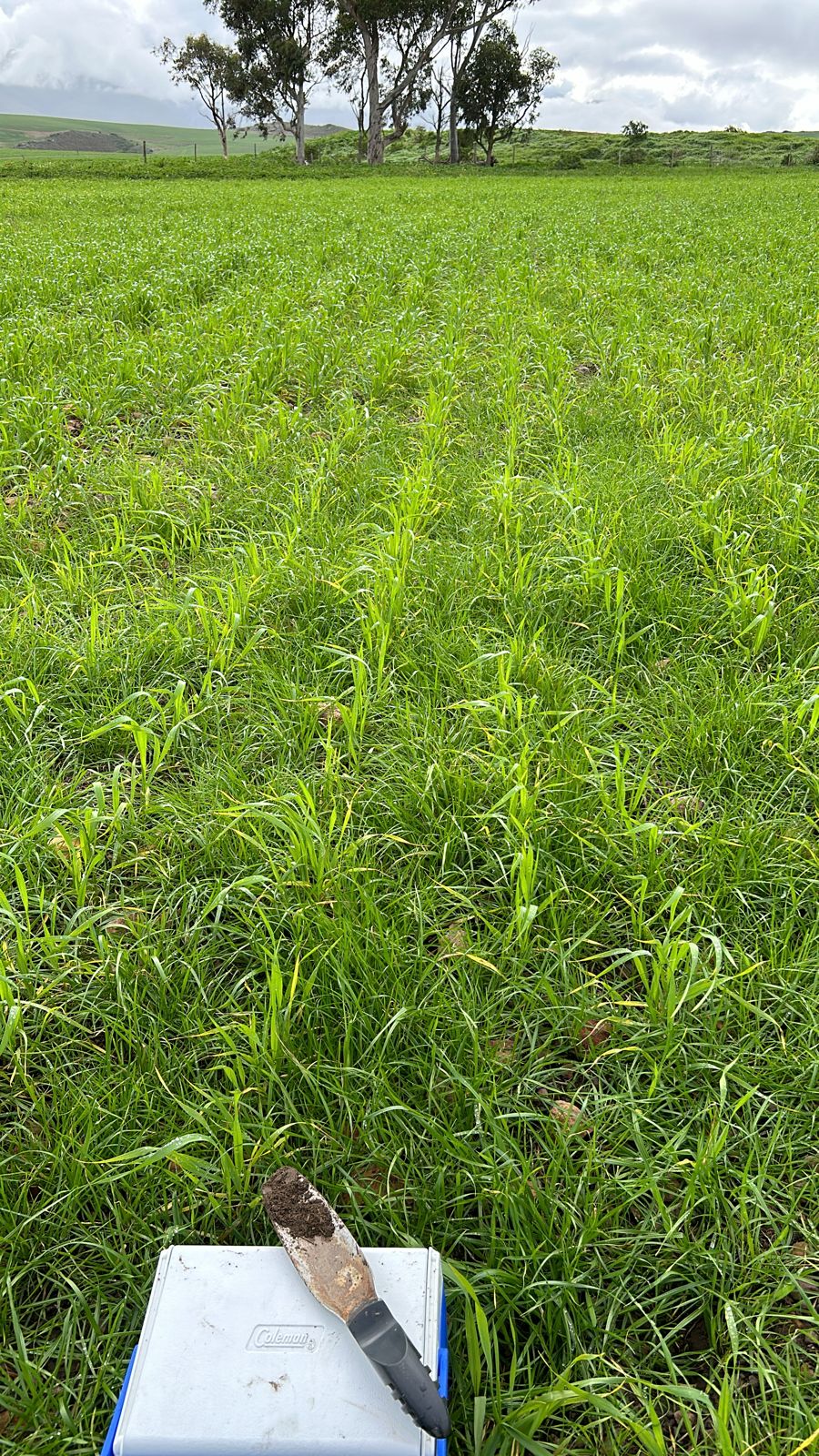
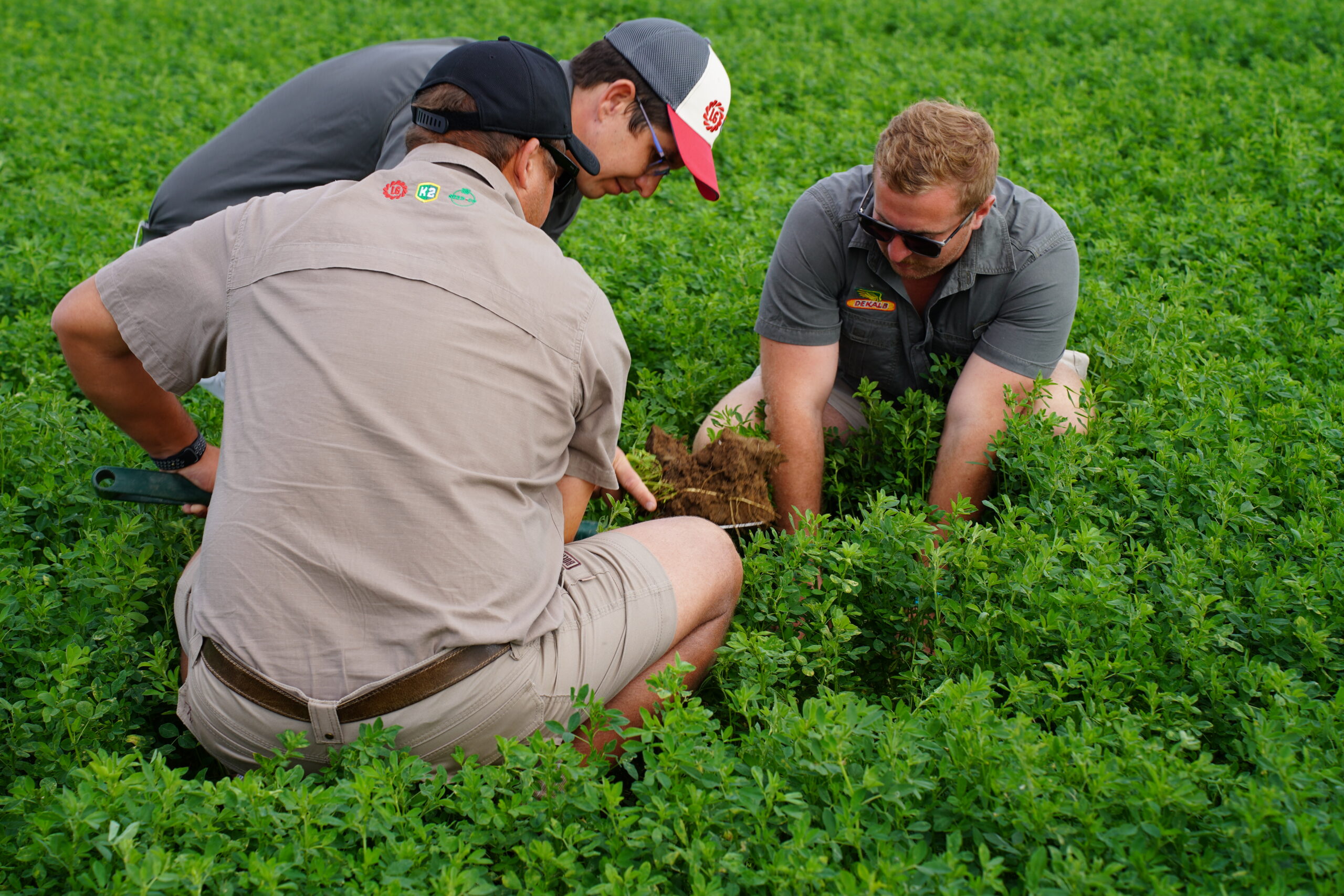
- Riaan van Lill tests the soil on which Zoutpansdrift’s lucerne has been planted.
-

- Dirk Coetzee, Wessel van der Merwe, Edrich Mulke and Riaan van Lill in the lucerne lands.
-
- Riaan van Lill says good lucerne starts with good soil.
Good lucerne starts with good soil
During a visit to Zoutpansdrift, Riaan van Lill, agricultural expert for Limagrain Field Seeds, said that the first step to good lucerne is good soil.
“It’s very important to ensure that you have enough soil depth before you establish your lucerne,” he says.
Since lucerne has a potentially deep root system, farmers must ensure that their soil can allow the root growth.
“Zoutpansdrift has well-drained apedal soil without high clay content. This is certainly some of the more suitable soil on which to plant lucerne,” he explains.
However, chemical barrier layers, such as carbonates, can hinder your lucerne growth.
Riaan reckons that if your soil has good drainage and no barrier layers such as rock fractions, clay or wetness, your soil is ready to plant lucerne.
Edrich Mulke from Zoutpansdrift is excited about their lucerne yield.
Choose the right cultivar
Now that you know you’ve got the correct soil, the next step is to obtain the best cultivar, and here Limagrain Field Seeds can help.
Two of their most popular cultivars are WL 525 HQ and WL 458 HQ – and they planted cultivar trials on the Mulke farm. Both these cultivars hail from America and from the same breeding programme.
WL 458 HQ is a dormancy seven cultivar that was introduced in South Africa in 2020, while WL 525 HQ has already been available in South Africa for almost 30 years. It is still one of the most popular cultivars among experts and South African farmers.
The suffix of both these cultivars, HQ, refers to ‘high quality’ and means that both cultivars are bred with specific quality characteristics. To get such a suffix, the cultivar must adhere to the quality standards of the breeder.
Both cultivars are also bred for effective resistance against root, crown and leaf diseases. The breeding process is done in this way so that the cultivars can resist the deadliest fungal spore diseases.
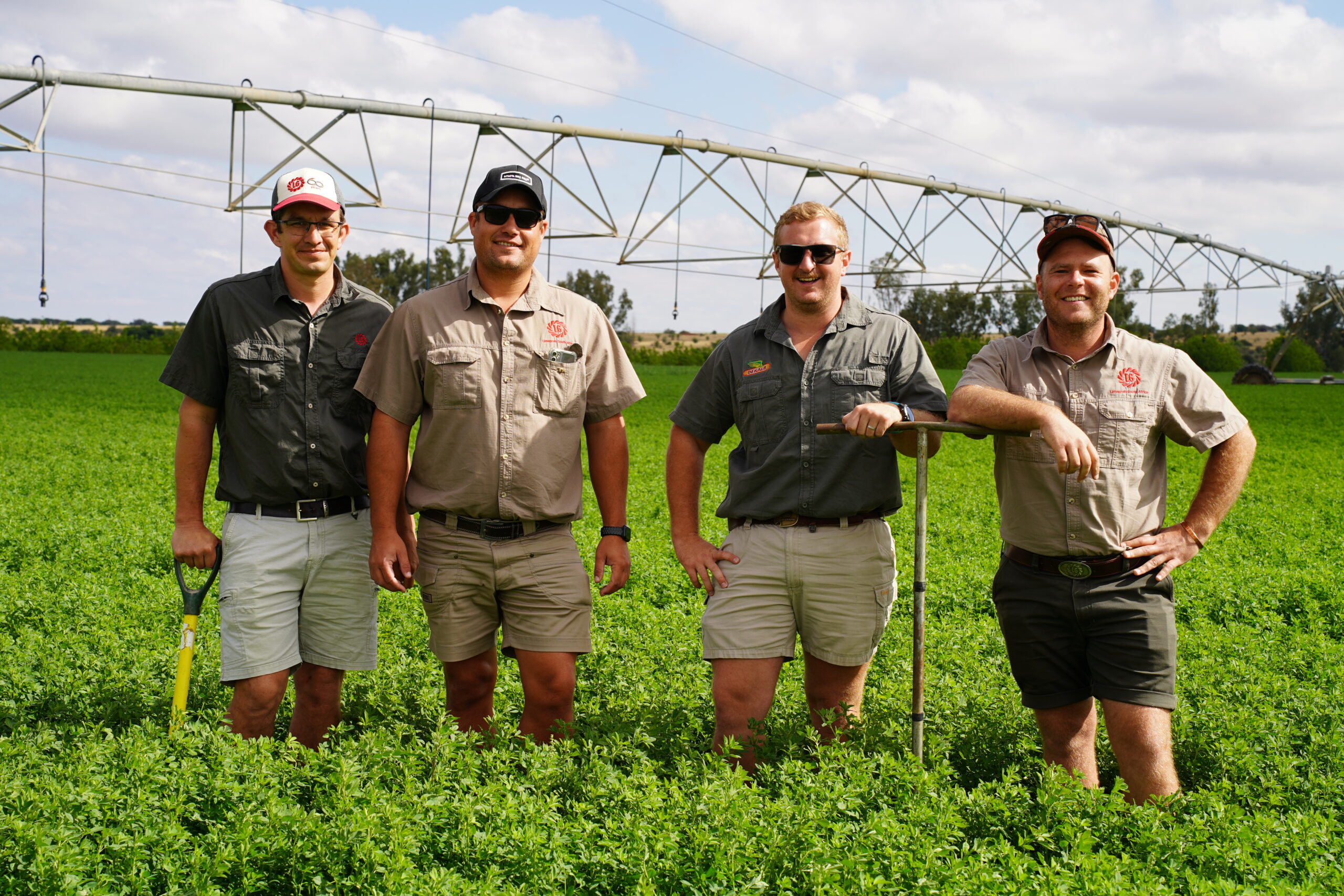
Dirk Coetzee, Wessel van der Merwe, Edrich Mulke and Riaan van Lill in the lucerne lands.
Why mix the two cultivars?
Dirk Coetzee, portfolio manager for grazing at Limagrain Field Seeds, explains that both cultivars are remarkable and that each has a specific application.
However, during the last few years, WL 525 HQ has become more expensive due to lower production and lower seed yields overseas. Therefore, it’s becoming more expensive to import WL 525 HQ to South Africa.
WL 458 HQ is a newer cultivar and therefore there’s more significant production globally – and better seed yields as a result, which makes this cultivar significantly cheaper.
“Farmers who initially planted WL 458 HQ have begun to notice that WL 458 HQ can keep up with WL 525 HQ in terms of yields, quality and production lifetime,” Dirk explains.
Because these two cultivars are so similar, farmers began mixing them.
Dirk says farmers who have already started mixing the two cultivars of their own volition have achieved unbelievable results.
“It makes sense to me, as I’m looking at it more technically. From trial data in the Northern and Eastern Cape, you can see that the two cultivars’ winter activity is very similar.
“A large part of the mixture’s success can be attributed to the fact that both cultivars are wheat-legume (WL) and HQ.
“They are managed very similarly, and by mixing them, farmers can lower their seed costs, but don’t have to forsake the quality of yield,” Dirk explains.

Healthy lucerne delivers the best crops.
The results speak for themselves
On Zoutpansdrift, the results speak for themselves. Under the first vector, they planted the mixed cultivars on 10 June 2025, and by mid-September, they could reap a harvest of 3,1 tonnes per hectare.
Under the second vector, they planted on 9 June 2025, and they could reap another harvest of 3,1 tonnes per hectare.
Under the third vector, they planted at the end of May, and they could reap a harvest of 3,2 tonnes per hectare.
-

- Dirk Coetzee investigates the lucerne’s root system.
-

- After the first cut, the lucerne is growing well again.
If you’re interested in finding out more about these two remarkable cultivars or any of Limagrain Field Seeds’ other products, please visit their website at www.lgseeds.co.za