The success of a hybrid is largely dependent on sound management practices. First and foremost, soil preparation – followed by the planter and the planting operation – plays a critical role. Agronomic practices aimed at creating an optimal root development environment are equally important.
Together with a well-adapted root system derived from strong genetics, this is a key means of improving nutrient uptake.
It’s essential to remember that maize roots must grow continuously to withdraw soil nutrients. Any agronomic practice that supports new root growth, improves maize yield. Practices such as eliminating soil compaction or draining waterlogged soils to promote improved root development enhance the potential for higher yields.
Soil is the primary source of 13 of the 16 nutrients required for maize growth. If any one of these 13 nutrients is limited, maize yield will also be limited. A favourable root environment reduces plant stress, which in turn has a direct impact on yield.
Functions of maize roots
There are essentially two primary functions of roots: absorption and anchorage of the plant. Roots also serve a conductive function, transporting water, minerals and nutrients to the above-ground parts of the plant. An important principle that is often overlooked is the relationship between the total leaf area and the root surface area.
The roots must be able to supply the above-ground parts with enough produced carbohydrates or photosynthate – energy obtained through the process of photosynthesis in the leaves. In addition, sufficient water and minerals must be supplied to the above-ground parts, and the leaves must provide enough food for root maintenance.
“Maize growers are working to develop yield potential in a hybrid, but they are realising that yield requires a root structure that protects and stabilises those yields,” says Jeff Schussler, a research scientist at Pioneer. “Root architecture is critical.”
Pioneer researchers are working to develop improved maize root architecture, with many fine root hairs to absorb nutrients near the soil surface, and deeply branching roots to access moisture in the lower soil layers.
Roots are complex. Each maize plant has tens of thousands of small roots. Because they are underground, they are difficult to study. When a plant allocates more energy to root growth, there is usually less energy available for grain production. Deep and well-distributed roots are important:
- Firstly, they must grow quickly downward into the soil, rather than spreading mainly laterally.
- Secondly, they must grow in a way that places less strain on the plant – with a metabolic rate that does not overload the plant or compromise grain production. Certain anatomical traits can make nutrient uptake ‘cheaper’ for the plant.
- Finally, the roots must have the ability to grow deep into the soil to access water when conditions require it.
Through photosynthesis, the leaves of the maize plant capture sunlight and carbon dioxide to produce sugars (photosynthate). These sugars are transported to the actively growing organs of the plant. Early in the plant’s development, sugars move to the roots, where they are converted into structural carbohydrates and proteins in the developing root tissue.
As the plant continues to grow, photosynthate is transported to the stem and leaves for temporary storage. After successful pollination, grain development places a high demand for carbohydrates on the plant. When the carbohydrate needs of the developing kernels exceed the amount produced by the leaves, stem and root storage reserves are mobilised.
University studies indicate that approximately 60% to 70% of the non-structural carbohydrates in the stem are relocated to other parts of the plant during grain filling – primarily to the ear (Daynard et al., 1969; Jones and Simmons, 1983). This stem depletion (also called stem cannibalisation) begins about two to three weeks after silking.
Environmental stress that reduces the amount of photosynthate produced by the plant can force plants to withdraw even greater percentages of stem carbohydrates, helping maintain grain-filling rates at the expense of the stem. As carbohydrates stored in the roots and stem are mobilised to the ear, these structures begin to decline.
Looking at the types of root angles and systems in Figure 1, it can be inferred that the roots of certain genetics perform better or worse under specific soil potentials or soil types with particular clay contents, thereby enabling better placement of hybrids.
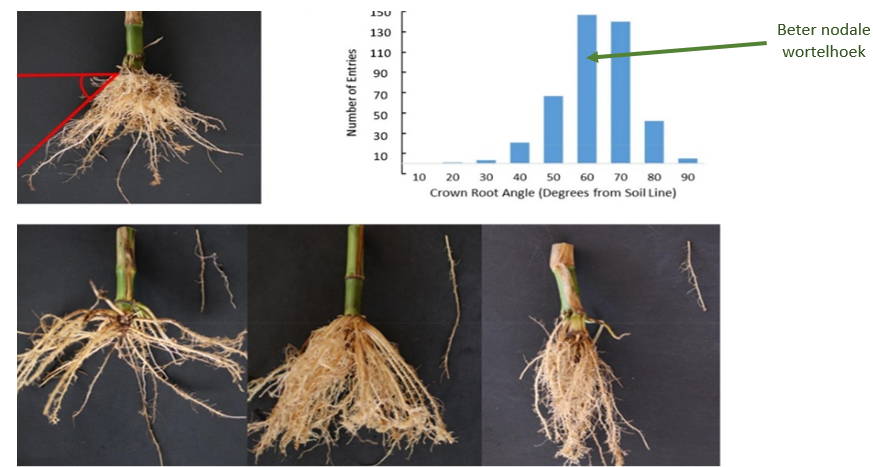
Figure 1: Types of crown root angles.
The P18011W platform is briefly summarised as follows:
It is a new, outstanding white hybrid with good yield potential across a wide range of areas in the east, classified as a medium-season hybrid. This platform can be used as a replacement for P2369W. It has a very attractive, large primary ear with good grain and cob mass. It is well adapted to any potential conditions and delivers good yields on higher-potential soils with early planting.
The platform has very good leaf disease tolerance, as well as good resistance to stalk and root rot. It is a large-framed plant capable of carrying ears high. It is also recommended to plant this new hybrid together with P2553W and P2553WR as a package. The PowerCore version should be planted with a refuge area.
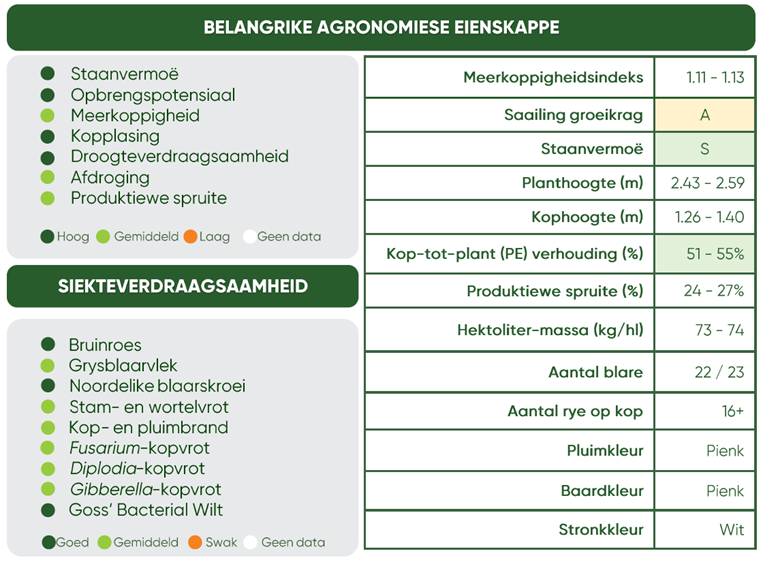
Here are the agronomical properties that can be used when deciding.
The following are the agronomic traits that can be used for decision-making.
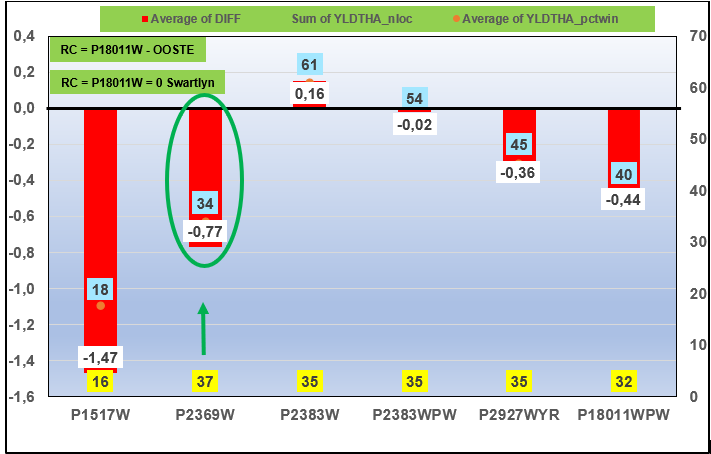
Figure 2: P18011W tested over two seasons in research trials across the eastern production region.
P18011W was tested over two seasons in research trials across the eastern production region. The colours in the graph above (Figure 2) represent the following:
a. White block: Yield difference (t/ha).
b. Blue block: Percentage (%) of hybrids outperforming P18011W, which is indicated as the 0-black line.
c. Yellow block: Number of comparisons.
An example of this is that P2369W outperformed P18011W in only 34% of the 37 comparisons, with an average yield difference of -0,77 t/ha.

Figure 3: A regression graph of P18011W in the eastern production region.
From the regression graph above (Figure 3), it can be inferred that P18011W = 1018D047-66 (red line) performs better than P2369W (green line) under all potential conditions, based on 37 comparisons. The grey dashed line represents the median – the point at which both hybrids yield the same. P18011W outperformed P2369W in 66% of the 37 trial comparisons, which amounts to 25 wins out of 37 comparisons. The average yield difference in favour of P18011W was 0,77 t/ha.
Summary
The P18011W and P18011WPW appear to be a platform with very good yield potential, adaptability and stability. In areas where P2369W has performed well in terms of yield, grain quality and disease tolerance, it is an excellent option to test this platform – in both the non-technology and technology formats. It should always be remembered that the performance of a hybrid depends on good management, thorough cultivation practices and correct placement.