Each year, Pioneer hosts its Agronomy Days, giving farmers in different regions the opportunity to see first-hand what Pioneer’s seed genetics can deliver on their farms.
This year, however, was extra special: the globally recognised seed company celebrated its 100th anniversary. To mark this milestone, they hosted not one, not two, but four Agronomy Days as part of their Agronomy Tour. The tour started in Sannieshof, moved on to Hoopstad and Harrismith, and concluded in Bethal. In addition to networking and the impressive fields, farmers also had the opportunity to engage with Casey Onstot, Global Vice President of Corn at Corteva Agriscience, discussing the future of Pioneer and exchanging ideas.
Although these four regions are sometimes only about 100 km apart, soil types and growing conditions differ significantly. Each Agronomy Day, therefore, focused on the specific needs of its area. On the final day, a panel discussion was also held with Pioneer and Corteva’s national and international leadership.
Where it all began
A century ago, the Pioneer brand was founded by Henry Wallace, who developed the very first hybrid crops, with maize being one of the earliest. Casey explains that over the past 100 years, Pioneer has advanced its germplasm and built on those crops and technologies to where it stands today – with nearly seven times the maize yield improvement compared to a century ago.
A stop in Sannieshof
The first day was hosted on Lourens van Wyk’s farm, Verdiend, in Sannieshof. Dirk van Niekerk, the area sales representative, explains that Pioneer has worked with Lourens for several years.
“Lourens is a very loyal customer who believes in our cultivars and recommendations. He enjoys planting trials and seeing how our cultivars perform under his management system in terms of yield and productivity,” says Dirk.
He believes trust is one of the most important factors between Pioneer’s representatives and their clients. That’s why Pioneer goes the extra mile to provide accurate recommendations and establish on-farm trials, allowing farmers to evaluate the data for themselves.
Charl de Wet, Pioneer agent in Lichtenburg and Coligny, explained that farmers in the area are looking for a strong, multi-ear white maize cultivar that performs well at lower plant populations.
“One of our biggest challenges is drought. If it weren’t for subsoil moisture this season, we would have received only about 19 mm of rain over six weeks. In this region, P2565 has performed well for some time, but we’ve now introduced P2565 PowerCore™, which has become the market leader. It’s not always the tallest maize, but its kernel mass is excellent,” says Charl.
For Nelis Potgieter, Pioneer’s area manager in North West, it was encouraging to see so many local farmers attend the Agronomy Day.
“These days are very important to us. We test many cultivars – both those already on the market and those still to come. Pioneer remains at the forefront of research, and trials play a key role,” says Nelis. He also highlighted technology such as G-Link, which helps farmers use normalised different vegetation index (NDVI) imagery and weather patterns to determine exactly where and how much input to apply, as well as optimal plant populations to improve yields.


P28022WPW – a new contender in the market
P28022WPW is a new white hybrid maize cultivar recently launched by Pioneer. Hennie du Plooy, area manager for the Western and Northern Free State, says this cultivar has generated strong excitement.
“We initially thought we would sell only a few bags of seed, but we are almost sold out. It performs particularly well in our area because of its strong multi-ear characteristics and lower planting density requirements. It also offers excellent grain quality,” he adds.
A wet day in Hoopstad
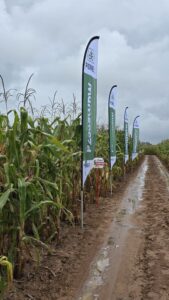
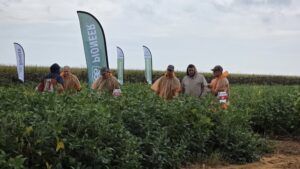
On day two of the tour, heavy rain set in, but thanks to good planning – and plenty of coffee and pancakes – farmers were still able to view the excellent fields on Chris Schoonwinkel and his son William’s farm, De Rots Boerdery / Morningtide Investments.
Hennie du Plooy explains that farmers in this region operate in a unique agricultural environment.
“There are few challenges here; these are some of the best agricultural soils in the country. We refer to them as deep water table soils. The only real challenge is excessive rainfall, which can quickly saturate the soil profile,” he says.
As a predominantly white maize region, Hennie notes that Pioneer offers a complete white maize package tailored to local needs. Braam Strauss, Pioneer’s agent in the Wesselsbron area, explained that they aimed to showcase as many Pioneer products as possible through the trials.
“In this region, P2565WPW has always been a reliable performer, but we’re excited to see how P28022WPW performs,” says Braam.
“Except for the sunflowers, which were hit by an 80 mm downpour after planting, we established the white maize trials at the farmer’s standard population of 27 000 plants per hectare and increased it to 56 000. We also experimented with fertilisation to evaluate its impact. The real test always comes at harvest, but we’re optimistic about the results. The success of these trials is largely thanks to Chris and William’s hard work.”
William, now the third-generation farmer on the family farm along the Vaal River, produces maize, sunflower, soybeans and wheat. Although he has been farming full time for only five years, he notes that they have been planting Pioneer trials for the past four years.
“It’s been rewarding to grow alongside Pioneer and see the progress being made. The further we go, the more excited we become about what Pioneer is doing.
“I feel positive about the trials. Although the demo plots took some strain from 100 mm rain events, this has been an above-average, high-potential season, and we are very satisfied,” William says.

What lies ahead for Pioneer?
Pioneer and Corteva invest approximately $4 million annually in research and development, says Casey Onstot.
“We don’t only think about today, but also about the challenges farmers will face in the future. We focus on insect control, as we believe 20 to 40% of global crop yields are still lost to insects. We also focus on weed control through herbicide-tolerant systems, plant disease management, fuel efficiency, market access and much more,” he explains.
For Casey, the future of seed technology at Pioneer is an untapped goldmine that begins with germplasm. According to him, there are still hundreds of thousands of germplasm combinations to be discovered, and Pioneer holds one of the largest global maize germplasm pools.
“We then add technology to capture as much yield potential from that germplasm as possible. Today we have excellent trait technology, such as PowerCore™, but as we move forward, the next generation of trait technology will introduce new insect traits, giving farmers additional modes of action to manage pests more effectively.”
Pioneer takes this even further by incorporating agronomic traits such as yield and yield stability to strengthen plants earlier in their growth cycle and increase overall productivity. For Casey, this tour provided a valuable opportunity to engage directly with farmers about their challenges and their vision for the future of agriculture in South Africa.
“Agriculture in South Africa is remarkable – it’s a beautiful country with outstanding resources and exceptional farming opportunities,” he concludes.