In an industry where every millimetre of rain and every kilogram of yield counts, cultivar selection plays a decisive role in the success of sunflower farming. Limagrain recently established sunflower trials with Gideon van der Walt on the Springbokvlakte. These trials allow farmers to see firsthand how different genetics perform under local conditions.
By planting cultivars side by side under the same soil and climate conditions, farmers gain a realistic picture of how each cultivar will truly perform in the field. It is exactly this practical approach that highlights the value of strip trials.
Practical value for farmers
The purpose of these trials is simple: to make reliable, practical recommendations. Differences in vigour, flowering stage, head size and yield potential can easily be observed when cultivars are planted directly alongside one another.
In a country like South Africa, where conditions vary drastically, this type of evaluation is critically important. What performs well in one region will not necessarily deliver the same results elsewhere.
Continuous product development
According to Anita Janeke, who is involved in Limagrain’s sunflower product development programme, the selection process is strict and ongoing:
“Over the past three years, we have evaluated between eight and nine cultivars per year in these types of trials. Ultimately, it comes down to yield and plant characteristics before a cultivar is commercialised. Over the past year, it was approximately four.”
Fanie Yssel, who is involved on the technical side, emphasises that yield remains the core focus.
“Selection starts with yield first and then plant morphology – the plant must stand well and show strong resistance to leaf diseases. But at the end of the day, it’s the combine harvester that does the talking.”
New genetics put to the test
Among the cultivars attracting attention are two new conventional sunflower cultivars:
LG 50745
This is one of the shortest-growing cultivars in Limagrain’s range, and even in the market. According to Anita, it’s ideal for quick planting windows:
“It’s a very short grower, perfect for early or late plantings when time is a factor.”
LG 50746
A slightly taller grower, but with higher yield potential:
“It’s a little taller than its brother, but it gives you better yield and market opportunities.”
Gandalf CLP
This Clearfield Plus cultivar stands out because of its stability and vigour:
“It’s a strong plant selected for its stability, and it’s four days faster than other commercial cultivars. Its bowl-shaped head helps ensure heavy seed set and good yield.”
The farmer’s perspective
For Gideon, the value of the trials lies in the practical insight they provide:
“What I value most about Limagrain’s trials is the variety of cultivars we can test every year. It gives us firsthand information about growth lengths and disease resistance, and it helps us manage risk because we never know what the season will bring.”
He explains that specific plant characteristics play a major role for them:
“The first thing we look for is heads that hang down. It helps significantly with bird damage, which is a major challenge for us along the Nile River. The head turn of Limagrain’s sunflowers can easily protect up to 10% of your crop.”
Growth length is another critical factor.
“Sometimes you only have a week or two to plant. Then a short grower makes a big difference.”
Management practices and plant population
When it comes to planting, Gideon follows a balanced approach.
“We plant approximately 60% to 70% Clearfield Plus but rotate it with conventional sunflower. This helps us rotate chemistry, because weeds remain one of our biggest challenges,” he says.
When it comes to plant population, they don’t chase extremes.
“We aim for approximately 31 000 to 32 000 plants per hectare. If we get 29 000 to 30 000, we’re very satisfied. We look for uniformity – the biggest head is not always the one with the most seed.”
He adds that oil content also plays a major role.
“With Limagrain’s cultivars, we see an average of around 45% oil. Naturally, this improves with good rainfall and a better season.”
Another standout aspect is plant uniformity.
“The height of the sunflowers is very even. It makes harvesting easier and shows that the cultivar performs consistently throughout,” says Gideon.
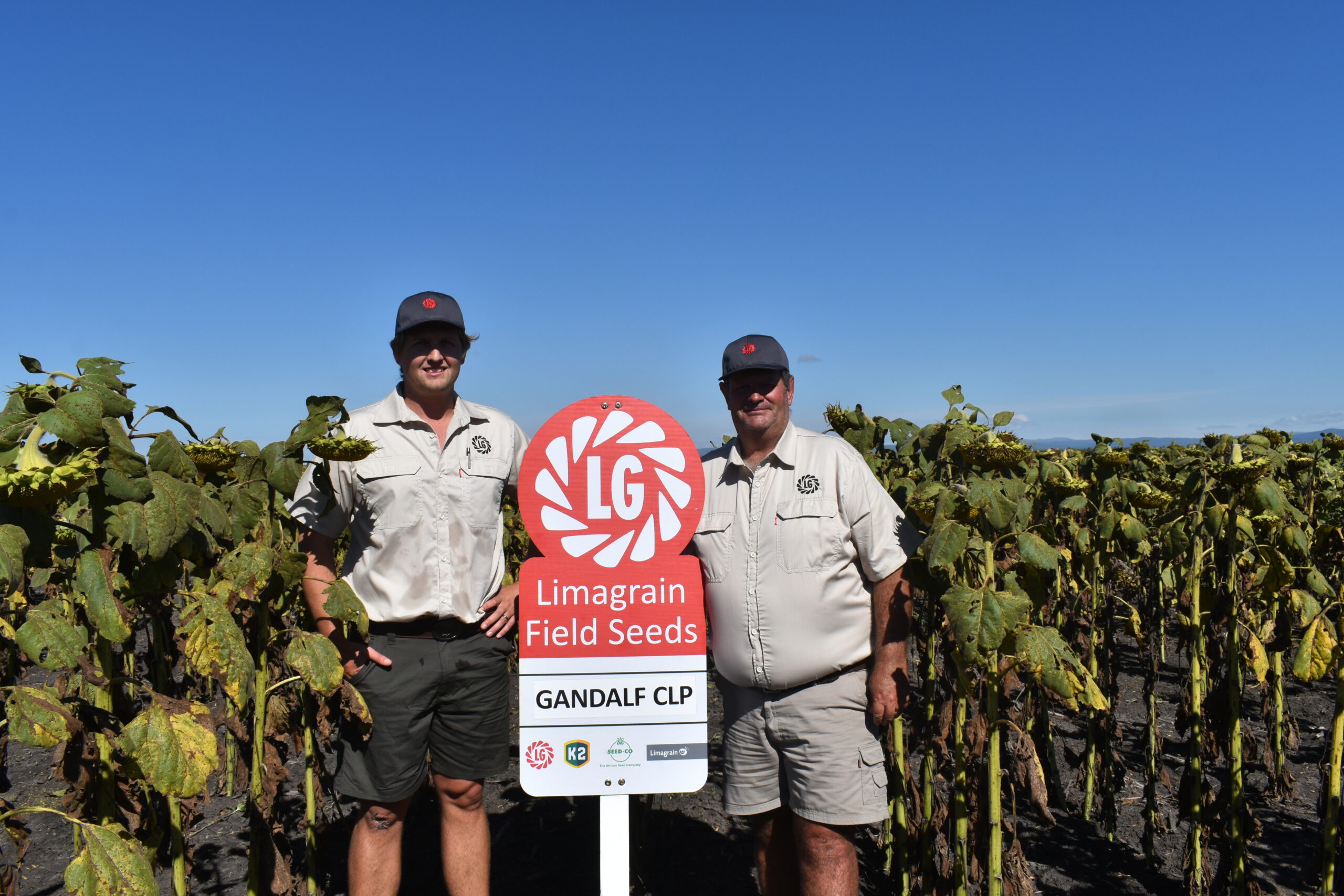
Gideon van der Walt, a farmer on the Springbokvlakte, with Lambert Blom, agronomist at Limagrain.
Stability remains king
Limagrain’s focus on genetics is clear in the approach they follow – cultivars that not only deliver high yields but also perform consistently under different conditions.
The trials demonstrate a wide range of characteristics:
- Adaptability to different climatic conditions
- Different growth lengths
- Disease resistance and stress tolerance
This diversity enables farmers to fine-tune their choices according to their unique circumstances.
Limagrain’s sunflower trials are proof of how research and practical farming complement one another. They not only provide insight into new genetics, but also give farmers confidence that their decisions are based on real field data. At a time of rising input costs and increasing risk, these trials remain an indispensable tool for protecting and ultimately maximising yield.
For more information about Limagrain’s sunflower cultivars and how farmers can benefit from them, call 017-647-6431, send an email to lgsainfo@limagrain.com, or visit their website at www.lgseeds.co.za