On the vast sandy soils between Viljoenskroon and Klerksdorp, farmers know that success does not depend on rainfall alone. The secret often lies beneath the surface, in the ability of roots to grow deep enough to access moisture and nutrients.
For JP Meintjes of Kruispan Farming, deep soil cultivation is therefore not just another agricultural practice, it is an essential investment in yield.
“Our water table is usually between 900 millimetres and one metre deep,” says JP. “That is why we always try to loosen the soil as deeply as possible, and for that we need a ripper to do the job.”
Kruispan Farming has been farming in the Viljoenskroon district for around 35 years, where deep sandy soils with high yield potential define the landscape. These soils are known for their good water infiltration and fertility, but they also present unique challenges.
The challenge of compaction
According to Paul Burger from Agrico, compaction is one of the biggest challenges on this type of soil. “The more sandy and deeper the soil is, the more prone it is to compaction. This compaction limits root growth, making it more difficult for crops to develop optimally and ultimately reducing yields.”
Although compaction is a natural process, it is accelerated by agricultural machinery traffic, water movement and other factors. This is why deep soil cultivation has been part of farming practices in the Northern Free State for decades.
“The older farmers in the area will remember that these soils were traditionally ploughed,” explains Paul. “But about 30 to 40 years ago, ripping became increasingly popular because it broke up compaction and made higher yields possible.”
Paul believes: “I have often heard farmers say that for every 100 millimetres deeper that you rip these sandy soils, you can gain between 400 and 600 kilograms of yield per hectare. It obviously differs from year to year, but over several seasons you can definitely see the benefits.”
According to JP, they try to cultivate (rip) the soil down to the clay layer to improve root development and increase the soil’s ability to absorb moisture.
“When we get good rainfall, you can see the effect in the water table. If we rip the soil deep enough, we can easily go two to three weeks longer without rain. It helps the roots reach moisture deeper in the soil,” adds JP.
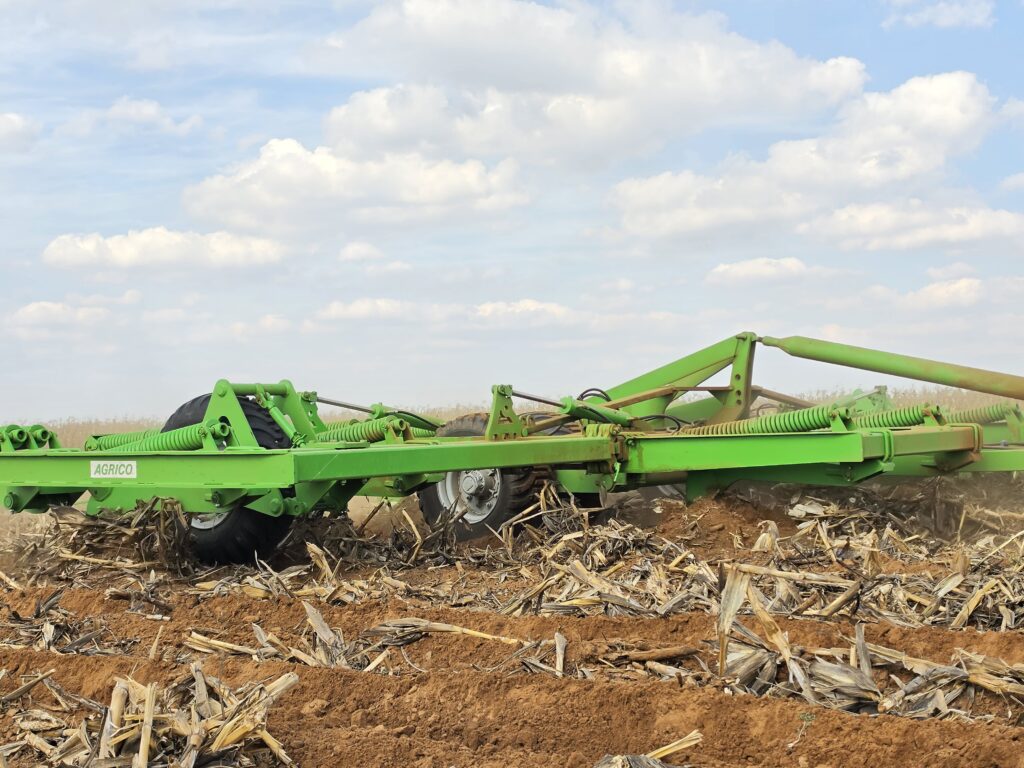
The Agrico T-Series ripper was specifically designed to break up compaction in deep sandy soils, thereby improving root development and moisture utilisation.
A ripper designed for maximum efficiency
To address these challenges, Kruispan Farming now uses an Agrico T-Series ripper that was specifically designed according to their needs.
The implement works in a tandem configuration. The front T1000 tine breaks open the upper soil layer, while the rear T1250 tine works deeper to further loosen the soil profile.
According to Paul, the design is intentionally aimed at reducing draft requirements. “The shanks are only 25 millimetres thick. This provides a smaller profile for the sand to work against and significantly reduces the pulling force required.”
The implement also uses an optimal 30-degree share angle, which helps break the soil effectively without unnecessary energy consumption. Like many modern Agrico implements, the T-Series is designed to be modular.
“Working widths, cultivation depths and kilowatt requirements differ from farm to farm. That is why we use modular tine technology and frames that can be adapted according to each farmer’s needs,” says Paul.
Lower fuel consumption, increased productivity
At a time when input costs continue to rise, fuel consumption is a critical factor for any farmer. JP was pleasantly surprised by the results delivered by the new ripper.
“Our previous rippers were about half the size of this one. At the time, we operated with a 410 horsepower tractor. Now we operate with a John Deere 9RX 830 and a 12,2 metre-wide ripper with 16 tines.”
The difference in fuel consumption was remarkable. “With the previous rippers, we used an average of between 14 and 15 litres of diesel per hectare. With this implement and tractor combination, we reduced it to around 12 litres per hectare, and in some areas even down to 11 litres per hectare. This is the lowest diesel consumption I have ever seen with a ripper doing this type of deep cultivation.”
The impressive John Deere 9RX 830 delivers a rated power output of 830 horsepower and a maximum of 913 horsepower. The 18-litre engine and four tracks ensure that this power is transferred efficiently to the ground.
For JP, however, the benefits go beyond fuel savings. “We have basically doubled the horsepower, but at the same time also doubled the size of the ripper. Where we previously needed two tractors and two operators, we now operate with one tractor and one operator with this combination.”
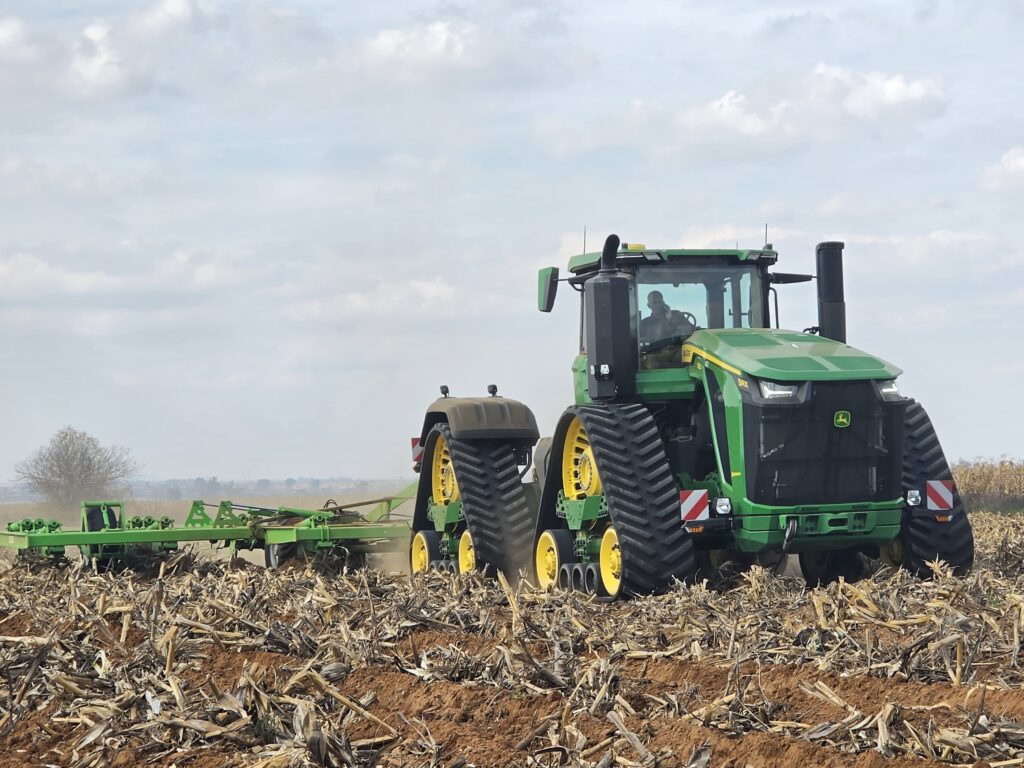
The impressive John Deere 9RX 830 effortlessly pulls the 12,2 metre-wide Agrico T-Series ripper through the challenging sandy soils of the Northern Free State.
No downtime when it matters
Another important advantage of the T-Series is the reset system. JP’s previous ripper used shear bolts. When a shear bolt breaks, the entire system stops until repairs can be completed.
“My previous implement was manufactured with a shear-bolt tandem ripper. It broke the soil well, but when a shear bolt breaks, the whole combination – tractor and implement – stands still. With a large tractor worth millions, you cannot afford to have that capital standing idle.”
The Agrico reset system solves this problem by allowing the tine to automatically return to its working position after hitting an obstacle in the field.
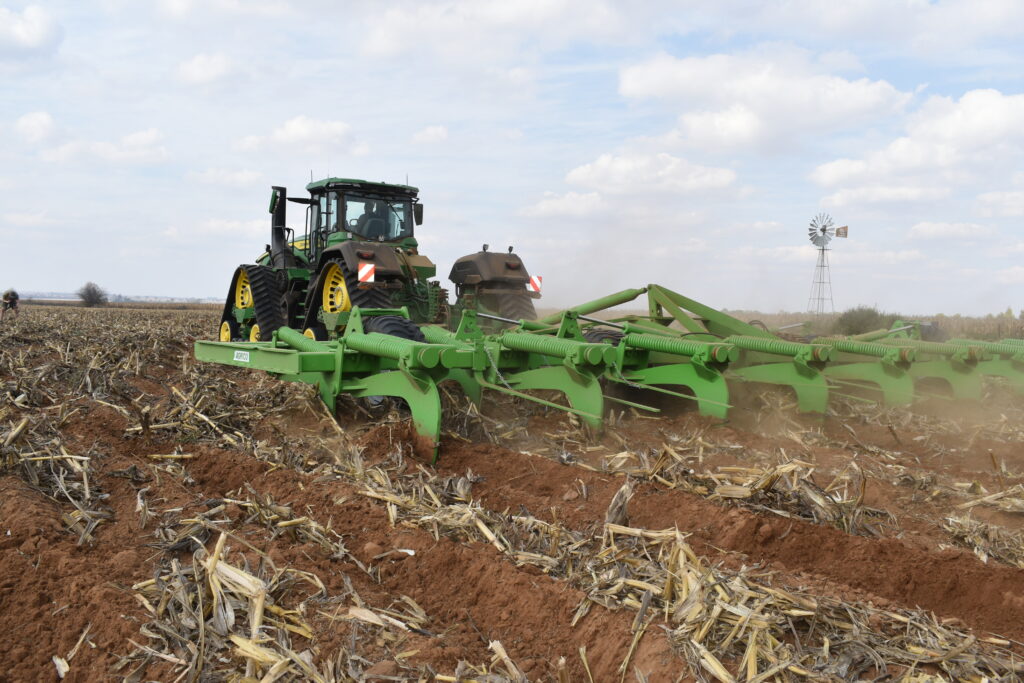
The unique tandem configuration ensures effective soil loosening at different depths without unnecessary energy consumption.
Stable and precise
Although JP was initially concerned about how the large trailing implement would handle behind the tractor, practical experience quickly eased those concerns.
“I was slightly worried whether the implement would stay straight behind the tractor. But the tine layout, the width of the implement and the long drawbar ensure that it stays perfectly aligned.”
According to him, the implement remains precise even under difficult conditions. “You do not get the feeling that the implement wants to move to one side or the other. Across all the hectares that we have already worked, we have seen how stable the implement operates.”
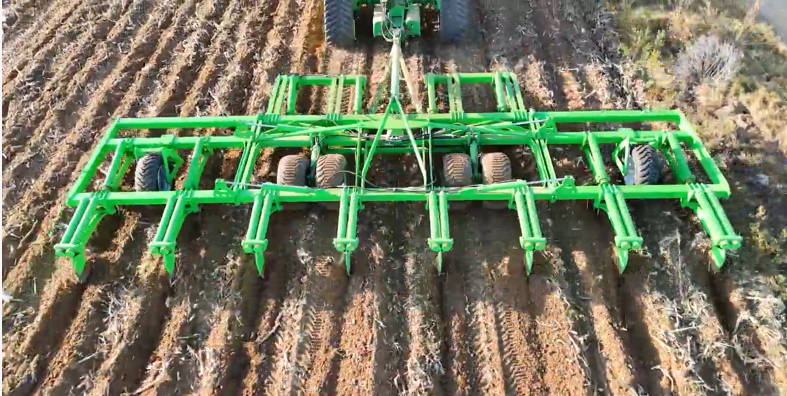
The 16-tine, eight-row Agrico T-Series ripper was designed and built according to the specific needs of Kruispan Farming.
An investment that proves itself
For Paul, the value of the Agrico T-Series is not only in its technology, but also in the economic impact it offers farmers.
“In Kruispan’s case, the cultivation practice was already correct. What Agrico added was lower fuel consumption and better utilisation of capital.”
However, where soil structure problems occur, the benefits can be even greater.
“When there are compaction layers or chemical horizons in the soil, this type of implement can not only reduce input costs, but also increase yields. In such cases, the implement can pay for itself rapidly.”
For JP, the proof is already visible: “With the current poor maize price, good yields help a lot. The first fields we harvested are producing above average, which is very positive for us.”
On the deep sandy soils of the Northern Free State, the recipe for success remains simple: open up the soil, allow roots to grow deeper and utilise every drop of water fully. With the right implement and the right approach, that potential is unlocked … one hectare at a time.

Paul Burger from Agrico and JP Meintjes from Kruispan Farming during a demonstration of the Agrico T-Series ripper on the deep sandy soils of the Viljoenskroon district.