Some 1,4 million people in Namibia are at present benefitting from the national drought relief programme, the Office of the Prime Minister announced that 1,4 million people in the country would be facing food insecurity due to drought by July, while the country has reported almost 2 000 cases of malnutrition this year.
The drought relief programme was extended to include malnourished households following the death of about 800 people in the Omaheke region during the 2022/2023 fiscal year.
At present, the programme assists over 384 935 households across all 14 regions of the country.
“Following the Cabinet decision to include malnourished households in the drought relief programme, a total of 1 835 households from five regions, including Kharas (744), Khomas (111), Omaheke (738), Omusati (66), and Oshana (176), have been assisted,” said Prime Minister Saara Kuugongelwa-Amadhila in response to a parliamentary enquiry.
The programme also supports 23 soup kitchens in the Omaheke region. The Prime Minister also referred to a collaborative initiative launched in October 2023 in response to these deaths.
“In the aftermath of the unfortunate deaths in Omaheke, a collaborative initiative was launched to enhance access to quality nutrition and protection services for vulnerable populations in Omaheke, Khomas, and Kunene regions,” she said. “The goal is to promote health, development, and wellness, while reducing preventable deaths and addressing inequities.”
So far, more than 9 204 pregnant and lactating mothers have benefitted. In addition, the government has strengthened Maternal and Child Health (MCH) days and outreach health services.
Also, 72 community health workers have been trained to increase nutrition awareness with the help of a Nutrition Hotline to address difficult inquiries.
In addition, government has expanded the Conditional Basic Income Grant (CBIG) programme, which was initially implemented in 20 urban and peri-urban areas from November to December 2024.
This initiative has registered another 15 000 households, so that a total of 21 697 households is now receiving CBIG support that initially benefitted 8 328 households that was transferred from the government’s food bank programme.
Omaheke the hardest hit region
About 800 people have died from malnutrition in the Omaheke region since 2022. The region also recorded 30 219 malnutrition cases in the same two-year period, announced Omaheke governor Pijoo Nganate in August 2024.
He said during the 2022/2023 financial year 14 774 new malnutrition cases were recorded through Nutritional Assessment Counselling and Support. He also said that there were 554 malnutrition deaths during the same time, and another 318 deaths the following year.
In July 2024, health and social services minister Kalumbi Shangula said about 1 101 Namibians died of malnutrition in the past four years.
Earlier in July, the Office of the Prime Minister had announced that 1,4 million people in the country would be facing food insecurity due to drought by July, while the country has reported almost 2 000 cases of malnutrition in 2024.
Nganate said his office was collaborating with the South African-based charitable organisation, HeadStart Kids Trust, to investigate the drought-stricken and malnutrition affected region’s needs.
“This is in order for us to craft sustainable mechanisms that deal with these issues holistically. We cannot act as though drought or malnutrition are phenomena that may never be dealt with. We, therefore, need to look for long-term solutions that bring forth the relief our farmers and citizens so deserve,” he said.
According to him, the total area of crop production in Omaheke dropped from 500 hectares in 2023, to less than 300 hectares in 2024. “Nearly 95% crop failures were recorded in the Omaheke region and farmers fallowed their land or turned the field into livestock feed,” he said.
About 800 people have died from malnutrition in the Omaheke region since 2022. (Source: Pixabay)
Increased hospitalisations and deaths
According to the Nutrition and Food Security Alliance of Namibia (Nafsan) the Omaheke is one of the regions hardest hit by malnutrition, with increasing cases of hospital admissions and deaths.
Nasfan noted in a report: “Contributing factors to malnutrition in Omaheke include lack of access to food, coupled with poor knowledge of proper complementary feeding and caring practices, poverty, high unemployment, alcohol abuse and insufficient provision of psychosocial support services.”
According to Nafsan director Ben Schernick, less than 25% of Namibians are actually food secure at present.
“Severity is still there and will prevail as long as inequalities in Namibian society are not adequately and efficiently addressed, for example through a universal and unconditional basic income grant of N$500 every month, for every Namibian from 0-59 years,” he said.
Schernick believes a multi-sectoral approach to address the issue of re-admission of malnutrition cases and deaths is possible by better linking hospital services with support systems in communities, thereby strengthening already existing community initiatives and referral systems.
Malnutrition rising
“The increase from a 3,74% malnutrition rate in 2022/2023 to 4,9% in 2023/2024, highlights a troubling trend that cannot be overlooked,” says social justice activist Nafimane Hamukoshi.
“While it is encouraging to see an improvement in treatment outcomes from only 2,7% success to 36%, this still indicates that a significant number of individuals remain untreated or inadequately supported,” she adds.
Hamukoshi says the government’s response has not been sufficient to address the root causes of malnutrition, namely poverty and lack of access to resources.
She believes a universal basic income grant could provide families with the financial stability needed to secure nutritious food, thereby reducing malnutrition rates significantly. “Enhancing community-based nutritional programmes and increasing funding for health services would further support vulnerable populations,” she adds.
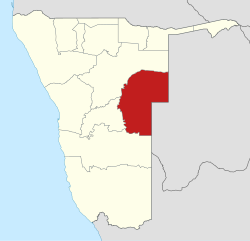
Omaheke, the Otjiherero word for sandveld, is the least populous of Namibia’s fourteen regions. Gobabis is the capital of the region. Source: https://en.wikipedia.org/wiki/Omaheke_Region)
Source references
1.4 million Namibians benefit from government drought relief programme. The Brief Issue 831, 2025. https://epaper.thebrief24.com/2025/February+/The+Brief_11+February+2025.pdf
Petersen, S., Matheus, E. (2024) 800 die of hunger in Omaheke in 2 years. The Namibian. https://www.namibian.com.na/800-die-of-hunger-in-omaheke-in-2-years/