At first glance, a drone may appear to be little more than a toy gliding through the air. In modern agriculture, however, this technology has rapidly developed into a powerful management tool. For farmers across Africa, and particularly in South Africa, where farms often span vast and rugged terrain, drones offer new ways to monitor crops, apply inputs with precision, and make decisions based on reliable data.
Drones can broadly be divided into three main categories: fixed-wing drones, multi-rotor drones, and hybrid drones. Each type possesses distinct characteristics that make it suitable for a range of agricultural applications.
Fixed-wing drones
Fixed-wing drones operate on the same principle as a conventional aircraft. Instead of using rotating rotors, they rely on aerodynamic wings and forward motion to generate lift and remain airborne.
This design enables the drone to travel longer distances and cover extensive areas efficiently. It is particularly valuable on large grain or grazing farms, where producers require a rapid overview of expansive fields.

A fixed-wing drone.
Key features:
- Wings: provide continuous lift and energy-efficient flight
- Propulsion system: typically electric or petrol-powered to generate forward motion
- Control surfaces: including rudder and elevator for stability and directional control
- Autopilot and GPS: allow pre-programmed flight paths for accurate mapping
Agricultural applications:
Fixed-wing drones are primarily used for large-scale field mapping and monitoring. Equipped with advanced sensors and multispectral cameras, they can rapidly collect data on crop health, plant density and soil conditions. On large farms producing grain, soybeans or maize, this technology enables farmers to identify problems such as drought stress, nutrient deficiencies or pest outbreaks at an early stage.
Because fixed-wing drones can cover vast areas in a single flight, they are particularly valuable for producers managing extensive croplands or grazing systems.
Advantages for farmers:
- Very long flight times and wide-area coverage
- High energy efficiency
- Well suited to large farms and commercial agriculture
Their main limitation is that they typically require space for take-off and landing, making them less practical for smaller farms.
Multi-rotor drones
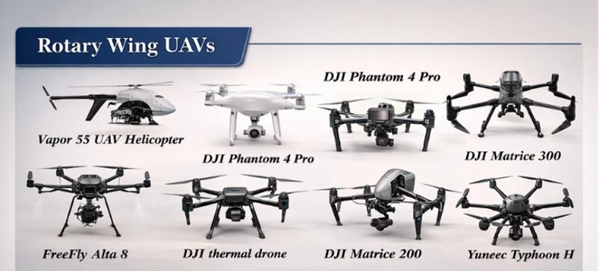
Multi-rotor drones are probably the most widely recognised models. They use multiple rotors or propellers to take off, hover and manoeuvre with precision. Most agricultural variants are available as quadcopters, hexacopters or octocopters. Their ability to take off vertically and remain stationary in the air makes them especially well suited to precision tasks on the farm.
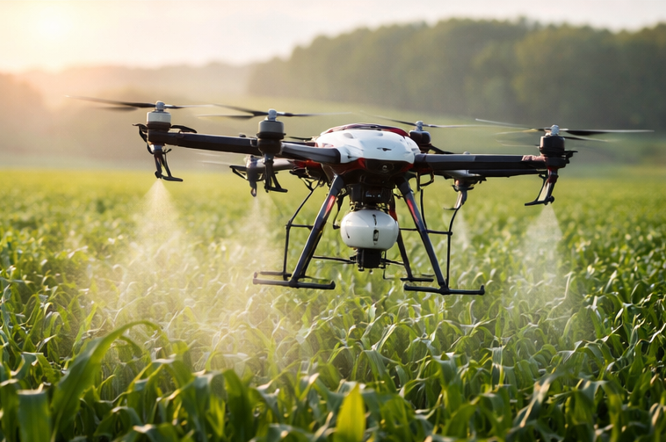
A multi-rotor drone.
Key features:
- Precise control and stability
- Ability to hover over a specific location
- Easy deployment without the need for a runway
- Compatibility with a wide range of sensors and spraying systems
Agricultural applications:
Multi-rotor drones can operate over a defined area and even hover in place. This makes them ideal for tasks such as precision spraying where pesticides, fertilisers or foliar feeds can be applied directly to targeted sections of a field.
In high-value crops such as orchards, vineyards and vegetable production systems, farmers can use these drones to monitor individual plants and detect problems quickly. They are also frequently used for detailed field inspections, enabling farmers to identify damage caused by wind, pests, or water-related issues.
Advantages for farmers:
- Excellent manoeuvrability, even in uneven terrain
- Ideal for smaller fields, orchards, and vineyards
- Relatively affordable and easy to operate (Strip-Till Farmer, 2017)
For many South African farmers – particularly those specialising in high-value crops such as citrus, grapes, and vegetables – multi-rotor drones are currently the most practical and widely used option.

Different types of multi-rotor drones.
Hybrid drones
Hybrid drones, also known as vertical take-off and landing (VTOL) drones, combine the strengths of fixed-wing and multi-rotor designs. They are capable of vertical take-off like a multi-rotor drone, before transitioning to fixed-wing flight for longer distances.
This technology is particularly useful in areas where large surfaces must be monitored but where no runway is available
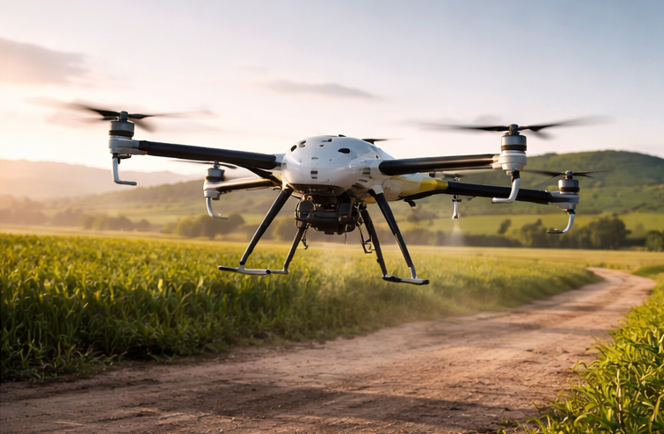
A hybrid (VTOL) drone.
Key features:
- Vertical take-off and landing
- Transition to energy-efficient horizontal flight
- Long flight times and wide-area coverage
Agricultural applications:
Hybrid drones combine vertical take-off capability with the efficiency of fixed-wing flight, making them especially suitable for large farms. They can be launched from a small open space and then fly across extensive agricultural areas to collect data.
They are often used for large-scale crop monitoring, water management, and precision agriculture analysis, where significant volumes of field data are required to support production decisions. In Africa, where many farms are located far from infrastructure such as runways, hybrid drones offer a practical solution for monitoring large areas quickly and efficiently.
Advantages for farmers:
- Greater coverage than multi-rotor drones
- No runway required
- Combines efficiency with practical usability (Asteria Aerospace Limited, 2023)
For African agriculture – where farms are often remote or expansive – this type of drone can serve as an ideal management tool.
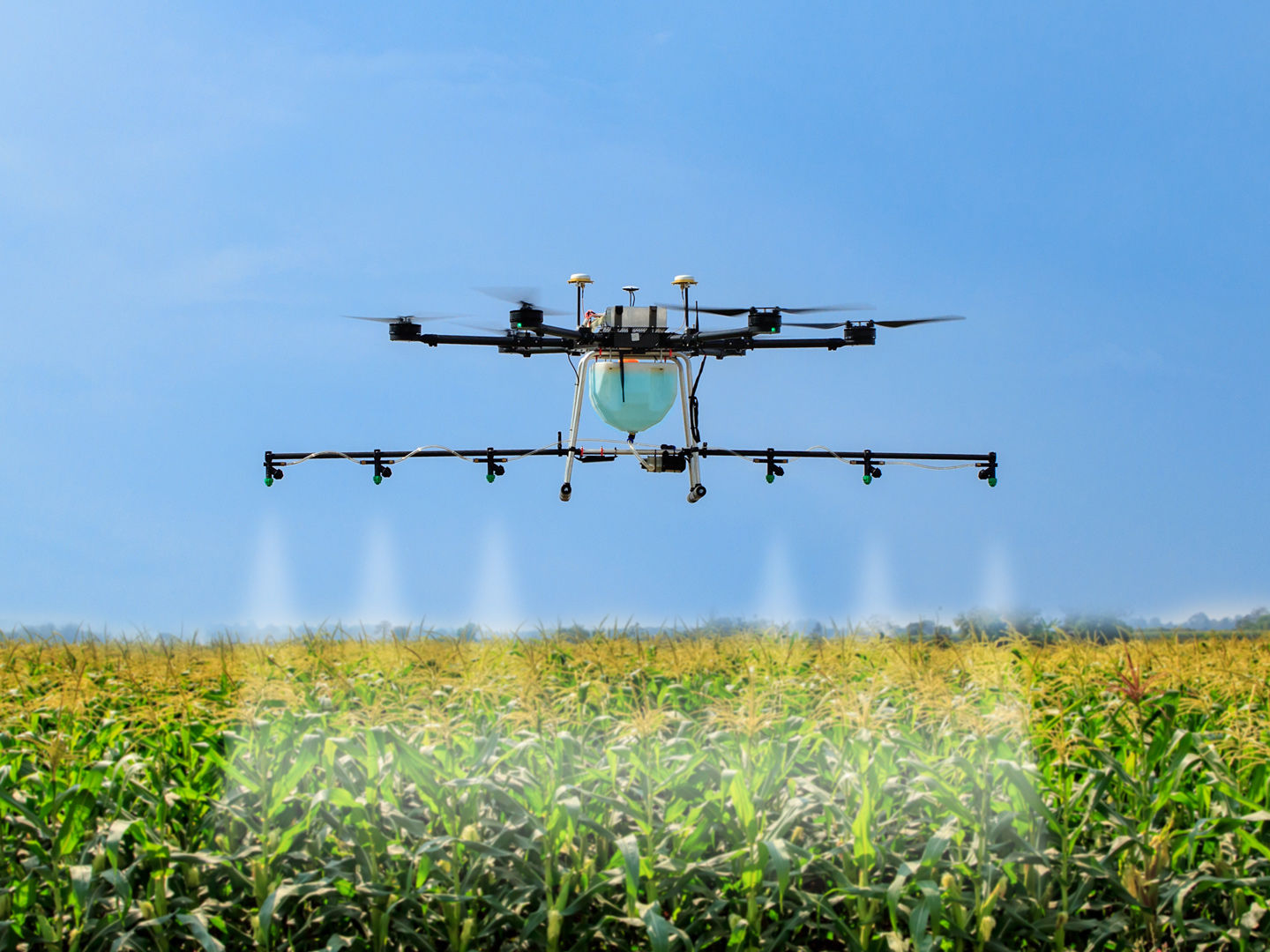
A hybrid drone spraying a farmer’s field.
Why drones are becoming increasingly important
Research shows that agricultural drones enable farmers to operate with greater precision and efficiency. Modern drones can, for example, apply inputs accurately, reduce labour requirements and collect valuable data on crop health, soil conditions and water management (Zhang & Kovacs, 2023).
Practical benefits for African agriculture:
- Precision farming: inputs are applied only where needed
- Labour savings: reduced reliance on manual labour
- Access to difficult terrain, such as steep slopes or waterlogged fields
- Improved decision-making: data enables faster identification of problems
As this technology becomes more affordable, it is clear that drones are no longer merely a novelty. In modern agriculture – from small-scale producers to large commercial farms – they are rapidly becoming an indispensable management tool in the sky.
 |
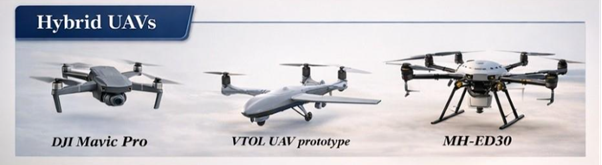 |
Different drone models.