This article was translated by the publication. Original article supplied in Afrikaans.
With today’s climatic and economic uncertainties, hybrid selection and placement are among the most crucial management requirements. Yield is, of course, the primary goal, and human and environmental factors must be managed to each producer’s ability. Climate risk plays the most significant role in moisture conservation, making the correct cultivation practices vital. Unfortunately, there is no one-size-fits-all recipe for the right cultivation practice.
Efficient soil preparation, along with proper planter and planting action, accounts for more than 80% of a producer’s success. The producer knows their soil best, and many tools are available to determine soil potential and types, which can be used to optimize management practices.
Efficient soil cultivation practices focus on ensuring that the planted crop can maximize production with effective and optimal moisture conservation. It is essential that soil cultivation is conducted in a way that allows the planted crop to survive relatively long dry periods. Therefore, no practice is as important as primary tillage.
Various factors influence the choice of a specific tillage system, such as soil, climate, season, environment, and weeds. The elimination of restrictive layers, both horizontally and vertically, plays a crucial role and must be identified first. This is essential for effective root growth. Compaction is particularly common in sandy, sandy loam, and loamy sand soils with low clay content. Plough pans can develop in medium- and high-clay soils when they are tilled too wet using heavy implements. Attention must also be given to chemical restriction layers.
Tillage goals and objectives:
- Aim to combine soil tillage and seedbed preparation methods to achieve the best results, despite varying soil moisture and rainfall conditions.
- Select and apply tillage practices to minimize soil moisture loss from winter to planting time.
- Since inadequate water is usually the limiting factor for production, all water conservation practices should be pursued.
- Maintain the soil surface to ensure maximum rainfall utilization throughout the year.
- This allows the farmer to plant early in the season when temperatures permit and to eliminate poor stands due to water shortages.
- Apply tillage practices so that plant roots can utilize the entire soil profile.
- Identify compacted layers in fields and break them up. Weak root systems lead to weak plants.
- Tillage and seedbed preparation should be geared towards achieving maximum efficiency in mechanical and chemical weed control.
- Avoid unnecessary tillage. Just as overly shallow tillage can lead to crop failure in certain conditions, unwise deep tillage can do the same. These guidelines also apply to inter-row cultivation.
- Perform all soil tillage at the correct soil moisture conditions.
- In times of economic pressure, focus on optimizing existing practices rather than investing in expensive new implements.
- Proper seedbed preparation is essential for good seed-to-soil contact, ensuring the seed absorbs the necessary percentage of its mass in water to germinate.
P18380 Summary
- P18380 is an exciting new yellow medium-short season hybrid with excellent stable yield potential for Eastern production regions.
- It is an excellent replacement for the P1788 and P2137 hybrids due to its superior agronomy, adaptability, and stability.
- P18380 is a single-ear hybrid that can compensate at lower plant populations and optimal conditions.
- This hybrid adapts well to plant populations between 30,000 and 50,000 plants per hectare across most soil potential types.
- It features strong agronomic traits, including a robust disease resistance package.
- P18380 places its ears high, much like the P1788 platform. Despite this, its standability is one of its strong agronomic traits.
- Fast emergence and vigorous seedlings are crucial for early planting and windy conditions, and P18380 meets this requirement.
- P18380 also has the ability to dry down quickly, facilitating an easier harvesting process.

“Table 1. Yield and moisture comparison between P18380 and P1788.”
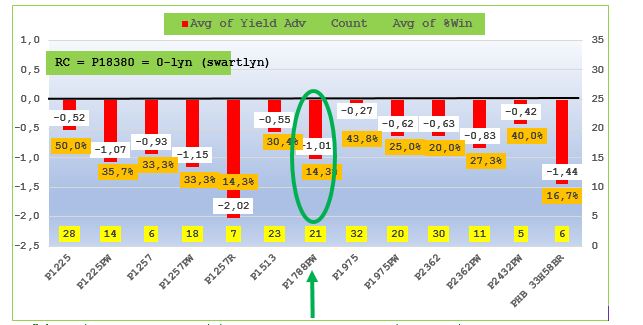
Graph 1. Yield and percentage (%) wins of P18380 against other Pioneer hybrids.
Graph 1 shows where P18380 was tested over one season in commercial trials across the Eastern production area. The following colours represent the following:
• White block = Yield difference (t/ha)
• Orange block = Percentage (%) wins of hybrids compared to P18380, which is the 0-line
• Yellow block = Number of comparisons
An example is where P1788PW wins only 14,3% of the 21 comparisons against P18380 and loses with an average yield of 1,01 t/ha.”
P2362R Summary
- The addition of P2362R to the P2362 platform enhances the good and stable yield potential in the Eastern production regions for the medium-long season market.
- P2362R is highly adaptable and stable across various soil types and yield potentials, performing well on most soils and row widths.
- It is a single-ear hybrid with the ability to produce a second ear at lower populations.
- In modern management practices, planting a package of hybrids with different season lengths is crucial.
- The P2362 platform pairs excellently with P18380, P1975, and P2432 in a hybrid package.
- This platform offers good agronomic traits, including attractive ear height and placement.
- It has a reasonable dry-down ability for its growth season class and is easy to harvest.
- P2362R produces very attractive grain with high carotene content.
- This platform exhibits strong standability and has a relatively thick stalk.
- It appears to show good tolerance to ear and leaf diseases.
- Under cool and stressful conditions, it may develop a reddish or purple hue due to slow sugar translocation, displaying anthocyanin symptoms.
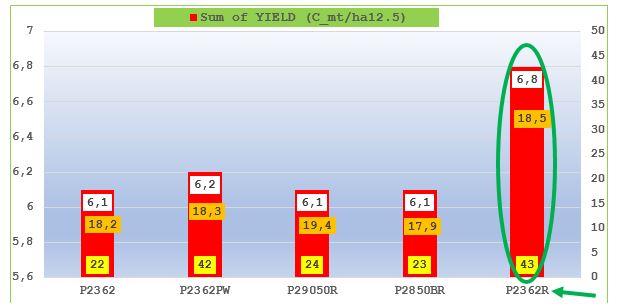
Graph 2. Yield and moisture percentage (%) of P2362R against other Pioneer hybrids.
Conclusion
Achieving consistent and stable high yields under a wide range of growing conditions is a challenge for most producers. Farmers want high-performing products under optimal conditions but also recognise the importance of stable performance under less favourable conditions.
Producers experience variations in growing conditions within fields, across different lands, and over multiple years. Yield and yield stability traits, combined with hybrid adaptability, enhance overall production when integrated with current agronomic management practices.
It is crucial not to make drastic management changes during drought or wet conditions. Stick to what works and minimise risk.
To conclude, it is essential for a producer to test genetics within their specific environment and management practices, as numerous variables impact yield.
For more information contact Pioneer by sending an e-mail to info.rsa@pioneer.com or visit their website www.pioneer.com/za