Dr Schalk Schoeman, widely known as South Africa’s “bug master” because of his extensive knowledge of controlling harmful insect pests in coffee and macadamia orchards, has decades of experience in this field.
“I grew up on a tobacco farm and always wanted to return to agriculture. After my military service, I had the choice of working on termites for the old Transvaal House in Pretoria or taking on a coffee project in the Lowveld. I chose coffee, and the rest is history,” says Schalk.
“Many of the coffee farmers later switched to macadamias and avocados, and I now work closely with these producers to develop integrated pest management (IPM) systems for these crops.”
When the macadamia felted coccid (Erriococcus ironsidei) was first detected in macadamia orchards in 2017, it had very few natural enemies. Because chemical pest control products are increasingly coming under pressure, Schalk believes biological insect control offers the best long-term solution for managing these destructive pests.
Beneficial insects such as ladybird beetles (Rhyzobius lophantae) and predatory beetles (Cybocephalus binotatus) have adapted well to Lowveld conditions and are now commonly found in macadamia orchards as natural enemies of felted coccid. The Agricultural Research Council (ARC) is currently evaluating whether the parasitoid wasp (Metaphycus macadamiae) should also be released to assist in controlling this scale insect.
“Less aggressive and more targeted methods of insect control are therefore the key to effective management,” says Schalk.
According to him, stink bugs are “without a doubt the biggest problem faced by growers here and elsewhere in the world”. Producers historically had very few control options available and consequently relied heavily on broad-spectrum insecticides. The widespread use of these products created secondary pest problems, which in turn required additional chemical intervention.
“Fortunately, several companies are now supplying biological products, and farmer training together with the testing of production systems has become critically important. There are already many success stories, but there are also pitfalls if products are not used correctly. Training and demonstration trials are therefore essential.”
Types of biological control
Classical biological control
Metaphycus macadamiae is usually released only once and has proven highly effective against felted coccid.
Augmentative biological control
Parasitic wasps such as Trichogrammatoidea cryptophlebiae, parasitoids of the macadamia nut borer and false codling moth (FCM), as well as Trissolcus basalis and other parasitoids (Telenomus spp.), are highly effective against stink bugs. For improved results, their natural population levels are supplemented through additional releases.

Dr Schalk Schoeman, one of South Africa’s leading experts on harmful insect pests in macadamia orchards in the Lowveld and Limpopo, and their control to prevent large-scale losses.
Conservation of predatory insects
- Use less harmful chemicals.
- Improve natural plant resistance through soil enhancers and optimal farming practices.
- Apply effective orchard floor management practices.
Biological control of stink bugs
Egg parasitoids, including green stink bug parasitoids, are widely available.
Other biological control options include:
- Neem oil, a natural insecticide derived from the seeds of the neem tree.
- Beauveria bassiana, a naturally occurring soil fungus.
- Metarhizium anisopliae, another naturally occurring soil fungus that causes disease in harmful insects by acting similarly to a parasitoid. It has delivered excellent results against red scale in apple and pear orchards.
During pheromone trials in avocado orchards, blue proved significantly more attractive to stink bugs than any other colour.
Additional recommendations include:
- Regular pruning is essential.
- Orchard floor management should be carefully maintained from flowering through to December.
-

- A parasitised macadamia nut borer egg showing the exit holes through which the parasitoid wasps emerge.
-
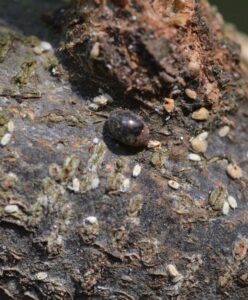
- Releases of predators such as mites provide excellent protection, particularly against thrips.
Options for nut borer control
- Augmentative releases of FCM and macadamia nut borer (MNB) egg parasitoids (Trichogrammatoidea cryptophlebiae).
- Soil applications of entomopathogenic nematodes and fungi.
- Chemical control must be integrated carefully with the release of beneficial insects – timing is critically important.
- Pheromones can be used to disrupt mating.
Important quality certification practices
When receiving egg cards containing Trichogrammatoidea cryptophlebiae, an egg parasitoid of FCM, growers should test the cards and record the following:
- Premature hatching
- Number of parasitised eggs
Keep in mind that one parasitised egg can produce up to three parasitoids when conducting counts. Egg cards should be tested approximately two weeks after placement to determine the hatch percentage or emergence rate. A strong hand lens or microscope should be used for this process.
Options for macadamia felted coccid control
- Ladybird beetles, which control felted coccid very successfully, were initially observed in low numbers on infested scales.
- It appears that these predators have now adapted to the host pest.
- Mealybug ladybirds (Cryptolaemus montrouzieri) were tested in cages but failed to establish successfully under field conditions.
- The ARC originally released predatory beetles to control mango scale insects. These insects have proven highly effective against various scale species and occur in large numbers despite their small size.
- Large populations of predatory beetles are now found in the Barberton Valley.
What producers should do now
- Supplementary releases of ladybird beetles are recommended.
- Ladybird beetles are highly sensitive to insect growth regulators (IGRs), making a conservation-based approach essential.
- Many growers currently use thiamethoxam. Although this product is not registered for scale insects, it controls stink bugs effectively. However, repeated use over large areas can lead to resistance development, especially if applied every season. Since the product also affects bees, label instructions should be followed carefully, and a conservation approach maintained.
Options for thrips control
- Pheromones will soon become commercially available.
- Pathogens can be applied, although they are not yet registered.
- Conservation agriculture practices remain important, including:
- Orchard floor management
- Careful pesticide selection, since thrips are primary pests, but their impact can worsen significantly when broad-spectrum products are used.
- Releases of predatory mites such as Amblyseius swirskii can provide effective control.

A significant felted coccid infestation on macadamia nuts.
Guidelines for augmentative parasitoid releases
For maximum effectiveness, the timing of parasitoid releases is extremely important.
- The ideal release time is two hours before sunset, while early morning releases are the second-best option.
- Parasitoids may also be released at temperatures between 22 °C and 29 °C, although establishment rates may decline because of increased dispersal.
- Releases should not take place at temperatures above 29 °C.
- Temperatures below 13 °C result in poor establishment rates, making 13 °C to 21 °C the ideal release range.
- Releasing insects during the heat of the day can reduce establishment by as much as 60%.
Additional release guidelines
- Relative humidity (RH) between 40% and 70% is ideal.
- Beneficial insects should be released before pest populations peak.
- Wind speed should remain below 8 km/h.
- Avoid releases when excessive rainfall is forecast.
Two-spotted stink bugs – the value of biological control
The following assumptions were made:
- Only one male and one female stink bug initiate the breeding cycle at the start of the season.
- Sex ratio: 66% female and 33% male.
- Female bugs produce 15 egg batches containing 14 eggs each.
- No natural mortality occurs.
By the third generation of their reproductive cycle, stink bug populations can reach alarming levels in macadamia orchards.
The dramatic reproductive potential of uncontrolled stink bugs is illustrated below. These population levels do not occur naturally because biological organisms help suppress pest numbers. Growers should therefore recognise the immense value of biological control.
| 1st generation | 1 female × 15 egg batches × 14 eggs per batch = 210 eggs × 0.66 (female ratio) = 139 females |
| 2nd generation | 139 females × 15 egg batches × 14 eggs per batch = 29 190 eggs × 0.66 = 19 265 females |
| 3rd generation | 19 265 females × 15 egg batches × 14 eggs per batch = 4 045 734 individual stink bugs |
Despite the many challenges facing agriculture, Schalk believes South African farmers stand out because of their resilience and innovation.
“I believe we have some of the best farmers on the planet. Climate change, together with various research and development challenges, makes life difficult for producers, but they continue to perform exceptionally well.”
Schalk concludes on a more personal note, highlighting both his humility and strong faith.
“I currently run my own company specialising mainly in integrated pest management across Southern Africa. I have been operating for two years now, and it has been the greatest adventure of my life.
“I have the privilege of visiting many beautiful places in Africa and meeting fascinating people. I thank my Creator every day for this privilege and for being able to share it with two of my former colleagues from Samac.”
For more information on biological insect control in macadamia orchards, email Dr Schalk Schoeman at goggameester@gmail.com.