The situation, the impact on South Africa and discussions between the two countries.
The Namibian situation
On 23 September 2026, Namibia announced that livestock had tested positive for foot-and mouth disease (FMD) in the Karas Region in the south of the country. All imports, exports and movement of cloven-hoofed animals and their raw products were suspended with immediate effect. As a result, Namibia’s livestock industry has essentially come to a standstill, with no source of income for any link in the livestock value chain.
At present, 129 animals on 17 farms in Namibia have tested positive for the virus (figures as at 6 October 2026, announced on 8 October 2026). All of these farms are in the same area as the index farm. Vaccination of the affected area has therefore already begun to prevent further spread.
Industry discussions
On 8 and 9 October 2026, the Red Meat Producers’ Organisation (RPO), together with Agri SA and RMIS, held discussions with the Namibia Agricultural Union (NAU), the Livestock Producers’ Organisation (LPO) and the Livestock and Livestock Products Board of Namibia (LLPBN). It is important to note that these were industry-to-industry talks. Neither country’s industry can make decisions on the way forward for managing the virus or marketing livestock and products, but we can help bring the industry’s view to the government level and, in so doing, try to influence potential decisions.
During the discussions, we were informed that Namibia is still weighing its options. The first option is to erect a veterinary cordon fence in the south of the country, thereby separating the south, with the current outbreak, from the rest of the country, and then to apply to WOAH again to have the central part of the country essentially declared FMD-free without vaccination. Another option may be to vaccinate the entire country, obtain recognition as FMD-free with vaccination as quickly as possible, and reposition the industry from there. The direction they take is entirely their decision; as the South African industry, we can only advise on how the different options might play out and the possible risks attached to each that should be kept in mind.
The impact on South Africa
The fact of the matter is that the outbreak in Namibia also affects South Africa, so it is not an isolated problem on their side. We have already seen sharp jumps in both lamb carcass and weaner calf prices – the two commodities we import most from Namibia. Weaner calves are reportedly selling at between R57/kg and R60/kg at auctions, while the A2 lamb carcass price has jumped by about R9/kg week-on-week in certain areas. Locally, many producers are celebrating the sudden surge in prices, but the question is: how sustainable is this trend, and are the current price jumps the result of a market shock or a genuine shortage due to the closed border?
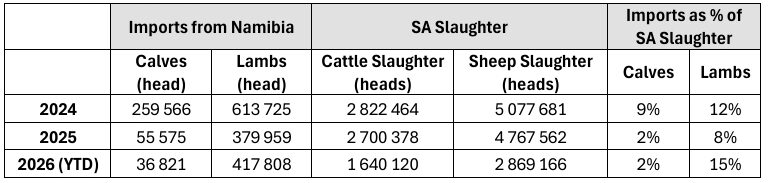
Import figures for the past three years for weaned calves and slaughter ready (fat) lambs are shown in the table.
Given the above figures, the sharp increase in the weaner calf price is more of a shock reaction than a market shortage, since year to date we have imported only about 2% of our total slaughter as weaner calves from Namibia.
The lamb picture is different, however: year-to-date, imports of slaughter lambs accounted for roughly 15% of our total slaughter. In this case, the suspension of imports may indeed have caused a shortage, and it is important to realise that the shortage is felt particularly at certain abattoirs whose capacity was developed over many years to slaughter Namibian lambs. At some South African abattoirs, Namibian imports make up more than 70% of total slaughter. With imports halted, competition for slaughter-ready lambs to keep these businesses going is fierce, and prices are rising sharply. This is not a sustainable situation, however, as the shortfall cannot be made up for by local lambs, and throughput will remain too low to keep the abattoirs viable.
Unfortunately, the FMD outbreak in Namibia also poses significant risks for us, which can be summarised as follows:
- South African sheep abattoirs are losing throughput and eventually having to close, leaving SA producers without their nearest slaughter facility.
- There is currently no alternative market for Namibian sheep, so these animals are simply building up in Namibia. The longer the border stays closed, the larger the influx of sheep will be when it reopens, causing our prices to fall significantly again (a downward price shock is often larger than an upward one).
- Since SA has always taken the bulk of Namibia’s sheep offtake and actually needs imports to keep some abattoirs viable, the future reopening of the border poses less of a risk to sheep than to cattle. Namibia currently has no market for its beef, and if, under the SACU Free Trade Agreement, virtually all of its beef and/or weaner calves are shipped freely to SA, it will have a major negative impact on our cattle sector. The inflow of cattle and/or beef will therefore have to be planned very carefully.
In conclusion
As South Africans, we are well aware of the devastating consequences of FMD, and we wish Namibia strength on the road ahead. This virus has the potential to cut off the livelihoods of more people than the number of animals it will kill, so fighting for market access and the survival of producers in the value chain is arguably even more important than fighting the virus itself.
Once again, as industries, we cannot make the decisions on FMD and international trade; we can only make our voices heard and try to influence the authorities in the interest of our producers’ survival. We would therefore like to call upon the governments of both countries to consult with each other as well as with the respective industries in order to find solutions that are in the best interests of both countries and their producers.
DR FRIKKIE MARÉ
CEO: NATIONAL RPO
frikkie@rpo.co.za